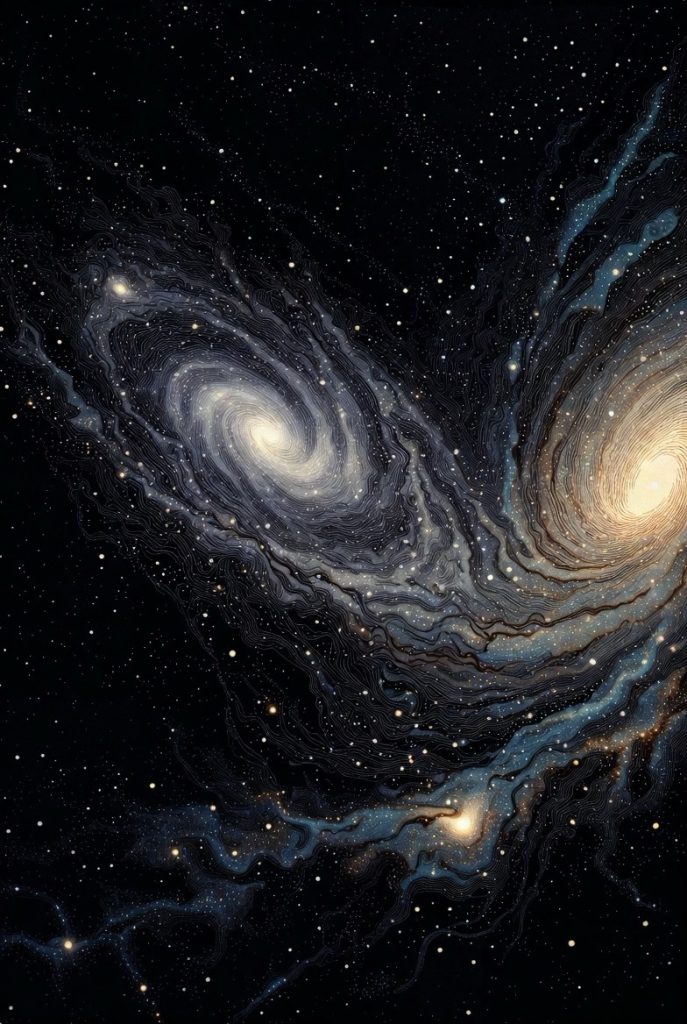
Galaxy collisions, like the future merger between the Milky Way and Andromeda in about 4.5 billion years, involve galaxies passing through each other due to vast empty space, making direct star or planet crashes extremely rare. Gravitational forces can distort shapes, trigger bursts of star formation, and increase supernovae or gamma-ray bursts, potentially harming life on nearby planets through radiation. However, for most stellar systems, orbits remain stable, and changes are minimal beyond a brighter night sky. By the time of such events, Earth’s surface will likely be too hot for life anyway, due to the Sun’s increasing luminosity causing a runaway greenhouse effect in 0.5-1.5 billion years. Overall, these mergers accelerate galaxy evolution and enrich the universe with heavy elements, indirectly fostering conditions for life elsewhere, but pose little direct threat to distant planetary inhabitants.
Long Answer
How Do Galaxy Collisions Impact Planetary Life?
Galaxy collisions, often more accurately described as galactic mergers, are among the most dramatic events in the cosmos. These interactions between massive star systems like the Milky Way and the Andromeda Galaxy reshape the universe’s structure over billions of years. While the term “collision” evokes images of destruction, the vast empty spaces within galaxies mean direct impacts between stars or planets are exceedingly rare. Instead, gravitational forces drive tidal interactions that distort galactic shapes, compress interstellar gas, and ignite bursts of star formation. This process not only influences universe evolution but also raises intriguing questions about habitability and the potential for life on Earth or elsewhere. Recent scientific studies, bolstered by data from telescopes like Hubble and Gaia, have refined our understanding, revealing that such events can both threaten and enhance conditions for planetary life.
The Mechanics of Galactic Mergers
At the heart of a galactic merger lies gravity’s inexorable pull. As two galaxies approach, their proper motion—measured through techniques like blueshift in spectral lines—brings them closer within groups like the Local Group, which includes the Milky Way, Andromeda, and dozens of smaller companions. Dark energy, the mysterious force accelerating the universe’s expansion, plays a subtle role by influencing large-scale dynamics, but on local scales, gravity dominates. Tidal interactions begin long before contact, stretching galactic arms and flinging stars into new orbits. When supermassive black holes at each galaxy’s core eventually merge, they release gravitational waves detectable by instruments like LIGO, along with bursts of accretion luminosity as surrounding material heats up and glows. These mergers can transform spiral galaxies into elliptical galaxies, which lack the organized structure of their progenitors but often host older, more stable stellar populations.
The Anticipated Milky Way-Andromeda Merger
Consider the anticipated merger between the Milky Way and the Andromeda Galaxy, a scenario that has captivated astronomers for decades. Initially projected to occur in about 4.5 billion years, recent analyses from 2025 using Hubble and Gaia data have downgraded the certainty. There’s now only a 50-50 chance of a direct collision within the next 10 billion years, with less than a 2% probability in the coming 5 billion. This revision accounts for the gravitational influence of nearby galaxies in the Local Group, which could deflect Andromeda’s path. If the merger does happen, simulations show the galaxies would pass through each other multiple times, their stars weaving intricate patterns without frequent crashes due to interstellar distances averaging light-years apart. For observers on a planet like Earth, the night sky would gradually brighten with Andromeda’s stars, but the overall structure of our solar system would remain largely intact.
Potential Threats to Planetary Systems
Despite the low odds of direct stellar collisions, galactic mergers aren’t benign for planetary systems. Gravitational perturbations could disrupt distant cometary reservoirs like the Oort cloud, sending icy bodies hurtling inward and potentially bombarding inner planets. This might alter planetary cores through impacts, reshaping geological features and even influencing the carbon cycle essential for life. More critically, the compression of interstellar gas during a merger triggers intense star formation, leading to a surge in supernovae. These explosions release high-energy radiation, including UV radiation and galactic cosmic rays, which can strip away planetary atmospheres or damage DNA in surface organisms. In extreme cases, if a planet passes near a merging galaxy’s bulge, exposure to radiation and solar wind equivalents could sterilize vast regions, challenging even extremophile organisms adapted to harsh environments like deep-sea vents or arid deserts.
Radiation and Its Effects on Habitability
Radiation poses one of the most significant threats to habitability during these events. Supernovae and active galactic nuclei from merging supermassive black holes emit gamma rays and other forms of high-energy radiation that could penetrate planetary magnetic fields, disrupting ecosystems. Galactic cosmic rays, accelerated particles from these explosions, might increase mutation rates or cause mass extinctions if flux intensifies. However, not all effects are detrimental. The same star formation bursts forge heavy elements through nucleosynthesis, dispersing them via supernovae winds. These elements—vital for building rocky planets and complex molecules—enrich the interstellar medium, indirectly boosting habitability across the universe. Research using merger trees, which trace galactic histories through cosmological simulations, shows that mergers contribute to the cosmic evolution of habitability, making galaxies more conducive to life over time as they stabilize and accumulate life-friendly materials.
Long-Term Implications for Life on Earth
From the perspective of life on Earth, the timeline offers some reassurance. Long before any potential Milky Way-Andromeda merger, our Sun will evolve into a red giant, its solar luminosity increasing by 35-40% over the next billion years. This will trigger a runaway greenhouse effect, boiling oceans and disrupting the carbon cycle that regulates Earth’s climate. By 1-1.5 billion years from now, surface conditions will likely become inhospitable to most life forms, rendering the merger’s distant effects moot for our planet. Yet, this solar fate underscores a broader point: planetary habitability is transient, influenced by stellar evolution as much as galactic events. Extremophile organisms might persist in subsurface niches, but complex life would face insurmountable challenges.
The Positive Role of Galactic Mergers in Fostering Life
Paradoxically, galactic mergers may have played a positive role in fostering life. Evidence from the European Space Agency’s Gaia mission suggests that a past collision between the Milky Way and a smaller galaxy around 8-11 billion years ago could have triggered the formation of our Solar System. This event compressed gas clouds, leading to the Sun’s birth and the subsequent assembly of planets. Without such interactions, the distribution of elements necessary for life—carbon, oxygen, and metals—might not have reached the outer galactic arms where habitable zones thrive. Studies on galactic habitability zones indicate that mergers enhance these regions over cosmic time, with stellar migration spreading potentially life-bearing systems outward from dense, radiation-heavy cores.
The Broader Cosmic Context
In the grand scheme of universe evolution, galaxy collisions are essential architects of change. They prevent galaxies from becoming stagnant, recycling material and driving the transition from gas-rich spirals to quiescent ellipticals. Dark energy ensures that mergers become rarer in the distant future, but in our epoch, they continue to sculpt the cosmos. For astrobiologists, these events highlight the delicate balance of habitability: destructive forces like radiation and supernovae must be weighed against creative ones like star formation and element enrichment. As we peer deeper with upcoming telescopes like the James Webb Space Telescope, our grasp of these dynamics will sharpen, offering profound insights into whether life persists amid galactic turmoil.
Conclusion: Balancing Destruction and Creation
Ultimately, while a galactic merger could pose risks to planetary life through elevated radiation and orbital disruptions, the odds favor minimal direct impact for most systems. Instead, these cosmic dances underscore the interconnectedness of scales—from planetary cores to supermassive black holes—and remind us that life’s emergence on Earth may owe a debt to ancient collisions. As research evolves, including merger tree models and habitability mapping, we gain a clearer picture of our place in a dynamic universe where destruction and creation are inextricably linked.