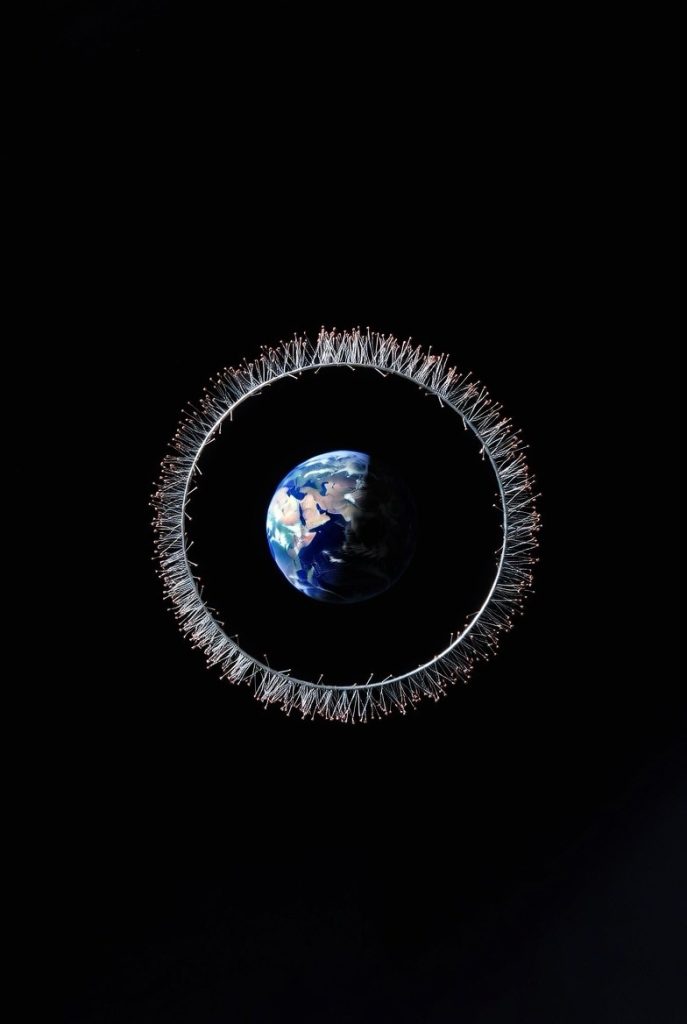
Project West Ford, a bold U.S. military experiment during the Cold War, aimed to create an artificial orbital ring by launching nearly 480 million tiny copper needles into medium Earth orbit to serve as passive reflectors for secure transatlantic radio communications when undersea cables or the natural ionosphere might fail. Developed by MIT’s Lincoln Laboratory starting in 1958, the 1961 launch failed due to needle clumping, but the 1963 mission succeeded, enabling successful voice and data signal bounces across continents. Astronomers worldwide strongly protested the intentional space pollution, fearing light and radio interference with observations, which contributed to provisions in the 1967 Outer Space Treaty and hastened the project’s abandonment as active satellites emerged as superior alternatives. Though most needles deorbited naturally, lingering clumps remain as an early symbol of orbital debris history, underscoring enduring lessons in balancing innovation with sustainable space practices.
Long Version
Project West Ford: The Ambitious Cold War Experiment That Scattered Needles Across Orbit
Picture this: in the height of Cold War tensions, the U.S. military launches hundreds of millions of tiny copper needles into space, hoping to weave an invisible web for unbreakable communications. This wasn’t a plot from a spy thriller—it was Project West Ford, a groundbreaking yet controversial endeavor that blended ingenuity with unintended consequences. As one of the earliest cold war space projects, it aimed to safeguard transatlantic links against sabotage or nuclear disruptions. Today, it stands as a pivotal chapter in orbital debris history, offering timeless insights into the balance between technological ambition and sustainable space practices. In this definitive exploration, we’ll unpack its origins, mechanics, triumphs, backlash, and lasting impact, equipping you with a thorough understanding of how this experiment shaped our approach to the cosmos.
Roots in Cold War Urgency: The Drive for Resilient Communications
The late 1950s were marked by escalating rivalries between the U.S. and Soviet Union, extending from earthly battlefields to the stars. Military leaders grappled with vulnerabilities in cold war communications, where undersea cables could be severed and the natural ionosphere—Earth’s charged atmospheric layer—might falter under high-altitude nuclear tests or solar activity. This prompted innovative U.S. military space experiments to ensure secure, jam-resistant channels for global operations.
Initiated in 1958 by Walter E. Morrow at MIT’s Lincoln Laboratory, Project West Ford—also known as Project Needles or Westford Needles—emerged as a radical solution. The concept: deploy 480 million copper dipoles into orbit to form an artificial ionosphere, acting as passive orbital reflectors for radio signals. These tiny antennas would bounce waves across oceans, creating reliable transatlantic space links independent of ground infrastructure. Named after the Westford, Massachusetts, site housing the Haystack Observatory’s parabolic dish, the project represented a mid-funnel leap in cold war orbital tech, prioritizing survivability in an era of uncertainty.
Engineers calculated that sunlight pressure would naturally perturb the dipoles, leading to deorbit within roughly three years—a design choice to mitigate long-term space waste. This foresight addressed early concerns about orbital clutter, yet the project’s scale foreshadowed debates on intentional space pollution.
Engineering the Orbital Ring: Technical Innovations and Challenges
At its core, Project West Ford was a feat of precision engineering. Each copper needle measured 1.78 centimeters in length—exactly half the wavelength of the targeted 8 GHz signals (with tests at 7750 and 8350 MHz)—and had a diameter of 25.4 micrometers in the first attempt or 17.8 micrometers in the second. These dimensions ensured optimal resonance as dipole antennas, reflecting microwaves without active power sources.
The needles were embedded in naphthalene, a material that sublimated in sunlight to disperse them evenly. Deployment targeted medium Earth orbit at 3,500 to 3,800 kilometers altitude, with inclinations of 96 or 87 degrees for near-polar coverage. This artificial space ring would span globally, enabling signal bouncing from ground stations like those at Millstone Hill, Massachusetts, and Camp Parks, California.
Key hurdles included:
- Dispersion Control: Preventing clumping to maintain a uniform belt for effective reflection.
- Orbital Dynamics: Accounting for solar radiation pressure to predict deorbit timelines and avoid persistent hazards.
- Signal Integrity: Ensuring the dipoles supported voice, data, and teletype transmissions amid atmospheric variables.
This setup exemplified early space-based innovation, blending materials science with radio propagation expertise to create a passive, resilient network.
The Missions: Trials, Setbacks, and Breakthroughs
Project West Ford unfolded through two primary launches, each testing the limits of 1960s rocketry and deployment tech.
The 1961 Attempt: Dispersion Failure and Early Lessons
Launched on October 21, 1961, via an Atlas-Agena rocket from Vandenberg Air Force Base, the first mission (West Ford 1) carried the payload into orbit. However, thermal effects and design flaws caused incomplete naphthalene sublimation, resulting in orbital needle clumps rather than a diffuse ring. These aggregates proved ineffective for communications, but the data informed refinements and highlighted risks in space clutter effects.
The 1963 Success: Validating the Concept
Refinements led to the May 9, 1963, launch (West Ford 2) as a piggyback on a MIDAS satellite. This time, dispersion worked, forming a functional belt. Tests confirmed the system’s potential: signals bounced successfully, enabling the first reliable transcontinental links via artificial ionosphere tech. Voice transmissions, data relays, and teletype messages flowed between coasts, proving copper needles in space could bridge gaps in cold war signal security.
Yet, the belt’s density faded within months due to perturbations, aligning with predictions but limiting longevity.
Milestones Achieved: Advancing Space Communications
Project West Ford’s successes extended beyond immediate tests:
- Proof of Passive Reflection: It demonstrated orbital dipoles as viable backups for disrupted networks.
- Data on Propagation: Insights into radio signal bouncing refined future cold war communications strategies.
- Influence on Satellite Evolution: The project accelerated shifts toward active systems, influencing military space race developments.
These outcomes underscored the era’s rapid progress, turning theoretical cold war orbital tech into tangible capabilities.
Global Outcry: Astronomers, Diplomacy, and Ethical Dilemmas
Innovation came at a cost. Space debris protests erupted globally, with astronomers fearing light-scattering debris would hinder optical and radio observations. The Royal Astronomical Society led British outcry, warning of telescope interference history and likening it to irreversible environmental harm. Soviet media, via Pravda, accused the U.S. of “dirtying space,” amplifying tensions.
The International Academy of Astronautics later deemed it the worst deliberate orbital junk release. At the United Nations, U.S. Ambassador Adlai Stevenson defended the temporary design, citing scientific assurances of quick deorbit. This controversy shaped Article IX of the 1967 Outer Space Treaty, mandating consultations for activities risking “harmful interference” with peaceful space use— a direct nod to orbital pollution ethics.
These astronomer space protests marked the birth of space environmentalism, highlighting ethical issues with orbital experiments.
Why It Ended: From Needles to Satellites
By the mid-1960s, Project West Ford’s abandonment reasons were clear: emerging active satellites, like Intelsat, offered superior reliability without debris risks. Protests and diplomatic pressures sealed its fate, shifting focus to sustainable space practices. This transition reflected broader U.S. military space experiments evolving toward controlled, efficient technologies.
Enduring Footprint: Debris Legacy and Modern Parallels
While most dispersed needles deorbited by the late 1960s, undeployed clumps from both launches persist. As of recent tracking, around 40 to 50 clumps larger than 10 centimeters remain, monitored by entities like NASA’s Orbital Debris Program Office. These persistent orbital fragments contribute minimally to the space waste crisis but symbolize early intentional space pollution.
- Link to Kessler Syndrome: They illustrate potential debris cascades, where collisions spawn more junk, threatening usable orbits.
- Historical Space Waste Milestone: As a precursor to modern clutter from satellite constellations, it underscores accumulation trends.
- Environmental Echoes: Brief light scattering impacted astronomy, fueling ongoing space light pollution debates.
In 2026, amid sustainability trends like AI-driven debris tracking and green space tech, West Ford’s story informs policy. It parallels contemporary challenges, such as managing orbital ecosystem damage from mega-constellations, and emphasizes mitigation like active removal.
Actionable takeaways include advocating for international guidelines, prioritizing deorbit tech in designs, and fostering collaboration to avert an orbital breakdown.
Wrapping Up: Lessons from a Needled Sky
Project West Ford encapsulates the bold, fraught spirit of cold war space projects—a daring bid for communication security that inadvertently pioneered space pollution awareness. From its technical triumphs and global backlash to its role in shaping treaties, it reveals the intricate dance of progress and responsibility. As we advance into an era of intensified orbital use, its nuances remind us to innovate thoughtfully, ensuring the final frontier remains accessible and pristine for all. This experiment didn’t just launch needles; it propelled a legacy of caution, guiding sustainable orbits in our shared cosmic future.