
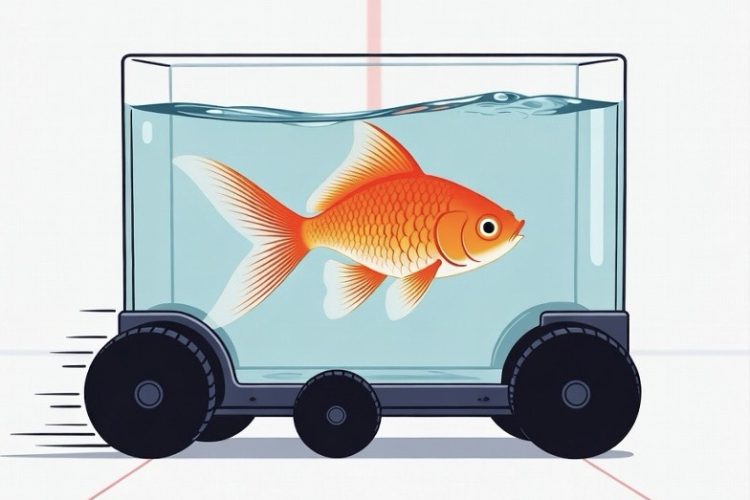
Goldfish can indeed learn to “drive” on land, as shown in a fascinating study by researchers at Ben-Gurion University of the Negev. They created a fish-operated vehicle (FOV)—a small robotic tank filled with water on wheels—that moves based on the goldfish’s swimming direction, tracked by a camera and LIDAR. Six goldfish were trained using food rewards to steer the vehicle toward a target in a room-sized arena. Through operant conditioning, the fish quickly improved, taking straighter paths, avoiding obstacles, and adapting to new starting points or distractions. This experiment debunked the myth of goldfish having only a three-second memory, proving they have strong learning, memory, and spatial navigation skills that work even outside water. A 2025 follow-up study showed goldfish can also adapt their movements when the vehicle’s controls were altered, highlighting their behavioral flexibility. These findings reveal that navigation abilities are universal across species and challenge assumptions about fish intelligence.
Long Version
Can Goldfish Actually Learn to Drive?
In the realm of animal behavior studies, few experiments capture the imagination quite like the one where scientists taught goldfish to navigate a terrestrial environment by driving a specialized vehicle. Conducted by Israeli researchers at Ben-Gurion University of the Negev, this groundbreaking study challenged long-held assumptions about fish cognition and spatial navigation abilities. Far from the three-second memory stigma often unfairly attributed to these creatures, goldfish demonstrated remarkable learning and training capabilities, adapting their behavior to operate a fish-operated vehicle (FOV) on land.
The Groundbreaking Experiment and Its Setup
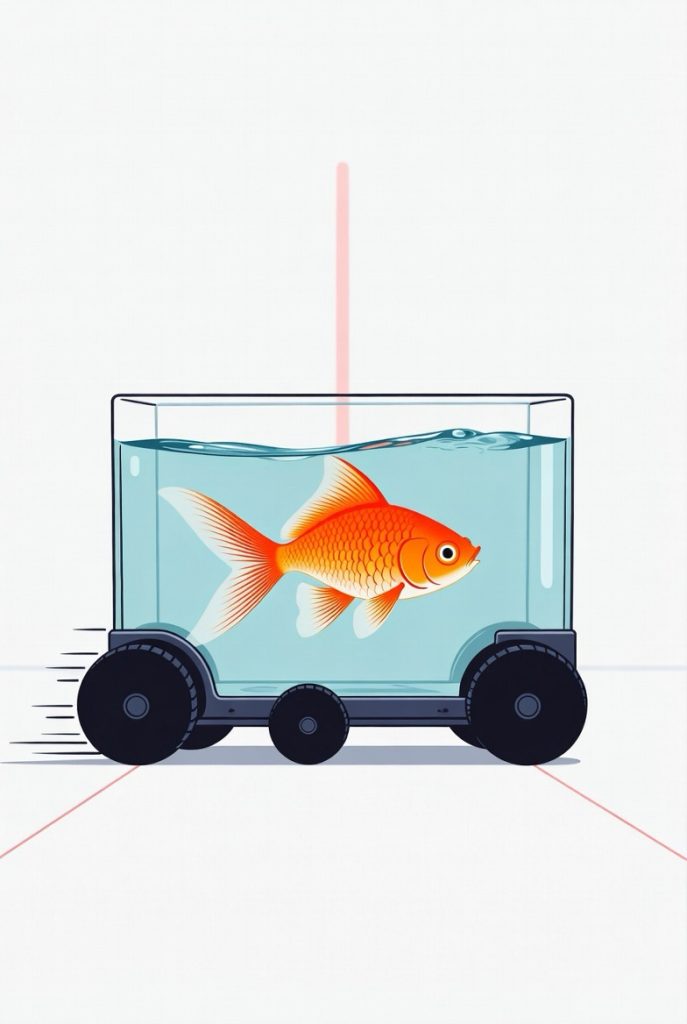
The core of this animal behavior study involved placing goldfish in a wholly unfamiliar terrestrial environment to test their navigation skills. Researchers designed a custom robotic tank—a water-filled motorized car equipped with wheels—that allowed the fish to “drive” across dry land. Known as the FOV, this vehicle measured approximately 40 by 40 by 19 centimeters and featured a chassis with four omni-directional wheels powered by DC motors. A transparent Perspex tank, filled with shallow water to minimize sloshing, housed the goldfish, ensuring their comfort while enabling movement.
Integrated motion sensing technology, including an overhead camera and LIDAR for precise positioning, tracked the fish’s location and orientation within the tank. If the goldfish swam toward a wall and faced outward, the system interpreted this as a command to propel the vehicle in that direction. Facing inward kept it stationary, preventing unintended motion. This setup transformed the fish’s natural swimming behavior into controlled driving, allowing them to steer the car toward designated targets in a 3-by-4-meter arena.
To enhance the understanding of the system’s precision, the control loop operated at around 12 frames per second, with the camera capturing the fish’s position at 30 frames per second for accurate tracking. The arena was carefully calibrated to ensure consistent environmental conditions, minimizing external variables that could influence the results.
Training the Goldfish: From Novice to Skilled Drivers
Six goldfish, each around 15 to 18 centimeters long, participated in the experiment. Adding a whimsical touch, the researchers named them after characters from Jane Austen’s Pride and Prejudice, with standout performers like Mr. Darcy and Mr. Bingley excelling in their tasks. The training relied on operant conditioning, a method where positive reinforcement shapes behavior through rewards.
Each session began with the FOV positioned at various starting points in the arena. The goldfish had to navigate toward a visual target, typically a pink corrugated board, to earn a small food pellet—about 0.002 grams—as a reward upon success. Over multiple trials, the fish honed their skills, learning to associate their movements with the vehicle’s response. Statistical analyses, including t-tests, revealed significant improvements in success rates from initial to final sessions, with the goldfish achieving targets more efficiently, taking straighter paths, and correcting errors like dead-ends.
Even when researchers introduced variables—such as changing starting positions, adding distractors, or altering the environment—the goldfish adapted, demonstrating robust cognitive abilities and spatial navigation prowess. This transfer of aquatic navigation strategies to a land-based context highlighted their ability to explore, avoid obstacles, and reach goals, much like higher-order animals. On average, the fish required about 24 sessions to reach proficiency criteria, such as achieving at least four successes per session with minimal deviations in path direction and length.
Debunking Myths and Uncovering Cognitive Insights
One of the study’s most compelling outcomes was its challenge to the pervasive myth of goldfish having only a three-second memory. By mastering the FOV, these fish proved they possess substantial memory and learning capacity, retaining training over sessions and applying it in novel scenarios. The experiment underscored that goldfish cognitive skills extend beyond simple reflexes, encompassing complex problem-solving and behavioral adaptation.
Published in the journal Behavioural Brain Research in February 2022 under the title “From Fish Out of Water to New Insights on Navigation Mechanisms in Animals,” the research concluded that navigation abilities are not strictly tied to an animal’s native ecology or brain structure. Instead, they appear universal, allowing species like goldfish to repurpose innate behaviors for unfamiliar domains. This domain-general approach to cognition suggests evolutionary conservation of spatial representation, offering broader implications for understanding animal intelligence across taxa.
Follow-Up Research: Motor Adaptation in Goldfish
Building on the original findings, a 2025 study by the same team, published in the European Journal of Neuroscience, explored motor adaptation using the FOV framework. In this extension, researchers introduced perturbations—such as a 45-degree right rotation of the vehicle’s movement relative to the fish’s orientation—to simulate altered sensory feedback. Twelve goldfish were trained, with eight completing the full protocol for the primary 45-degree perturbation group, while smaller groups tested 90-degree and -45-degree rotations.
The timeline included baseline training (up to 25 sessions until criteria met), followed by 15 sessions with the perturbation, 10 washout sessions without it, 15 savings sessions reintroducing the perturbation, and 10 final sessions. Trials lasted up to three minutes, with successes rewarded by food pellets. Goldfish responded by adjusting their swimming bouts: increasing frequency opposite to biases and decreasing it opposite to gain changes to still reach targets. Performance metrics included success rates (0-6 per session), angular error (optimal 0 degrees), and distance traveled (optimal around 2.5 meters).
Results showed clear adaptation: success rates improved from about 1.9 to 3.4 per session, angular errors reduced from 11.4 degrees to near zero, and distances shortened from around 5 meters to 3.8 meters. Aftereffects appeared during washout, with temporary dips in performance that recovered. However, unlike in mammals, there was no clear “savings” effect—relearning occurred but not significantly faster than initial learning, with initial learning rates lower in the savings phase. Bayesian hierarchical models confirmed these trends, using exponential learning curves and metrics like highest density intervals for statistical rigor.
Individual variability was noted, with some fish failing baseline or showing negative correlations in learning rates across phases. This adaptation of whole-body movements further illustrated the fish’s flexibility, providing a novel model for studying motor control in aquatic species. It reinforced the FOV’s value as a tool for probing behavioral plasticity, showing how goldfish refine their skills under challenging conditions and highlighting potential differences in motor learning mechanisms between fish and mammals.
Broader Implications for Science and Beyond
This series of experiments not only elevates our appreciation of goldfish as intelligent beings but also advances fields like neuroscience and robotics. By revealing that cognitive and navigation abilities transcend environmental boundaries, the research encourages reevaluation of animal capabilities and inspires innovative studies on learning and behavior. For scientists and enthusiasts alike, it serves as a reminder that even seemingly simple creatures can surprise us with their ingenuity when given the chance to “drive” their own discoveries. Future work could explore neural correlates of these adaptations or apply similar paradigms to other species, further bridging gaps in comparative cognition.
Hashtags For Social Media
#GoldfishDriving #FishIntelligence #AnimalCognition #ScienceFacts #AnimalFacts #DidYouKnow #FunFacts #MindBlown #CoolScience #WeirdAnimals #AnimalBehavior #ScienceExperiment #ViralScience #AmazingAnimals #SmartAnimals #FishFacts #AnimalLovers #WildlifeFacts #ScienceIsCool #WowFacts #InterestingFacts #DailyFacts #NatureFacts #CuteAnimals #AnimalsOfInstagram #Animallovers #Science #Facts #DidYouKnowFacts #AnimalScience
Related Questions, Words, Phrases
can goldfish learn to drive | do goldfish really drive cars | goldfish driving experiment explained | can fish drive on land | goldfish operated vehicle study | do goldfish have good memory | fish intelligence goldfish driving | ben gurion university goldfish car | goldfish debunk memory myth driving | surprising facts about goldfish driving | how scientists taught goldfish to drive | goldfish navigation on land experiment | can a goldfish steer a vehicle | proof goldfish are smart driving test | robotic tank goldfish driving research


