

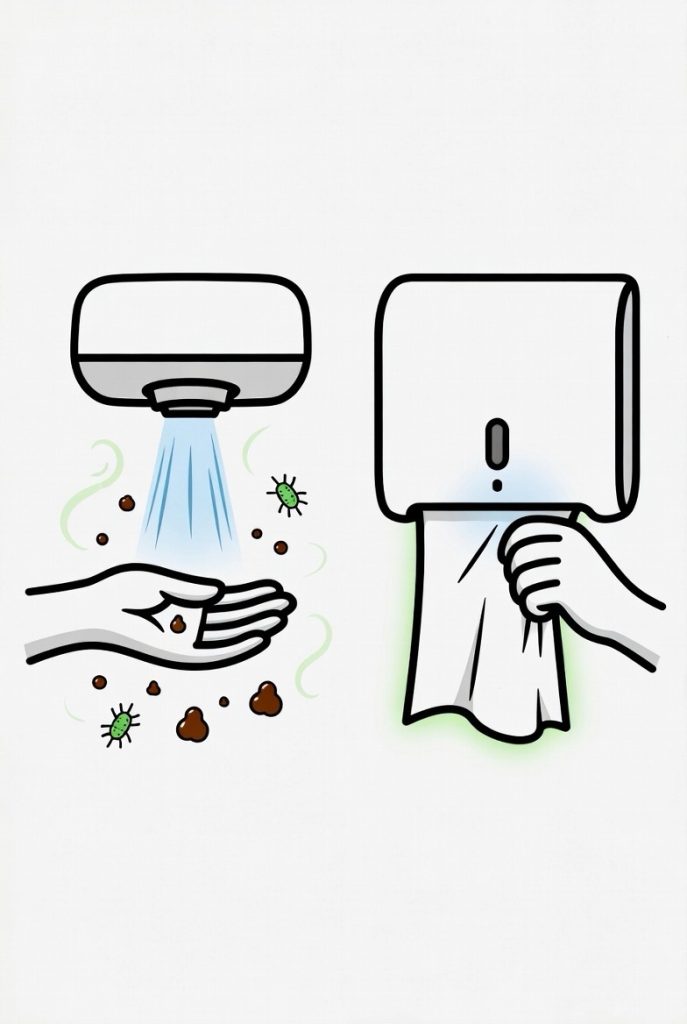
Public restroom hand dryers, especially hot-air and jet air models, can spread germs and fecal particles, undermining hand washing efforts. When toilets flush without lids, a “toilet plume” aerosolizes poop particles, bacteria, and bacterial spores into the air. Dryers suck in this contaminated air and blast it out forcefully, depositing pathogens onto clean hands and nearby surfaces—causing bacterial splatter that lingers for minutes. Studies show jet dryers disperse far more viruses and bacteria than paper towels, contaminating masks, walls, floors, and door handles significantly more. Paper towels dry hands thoroughly using friction, removing residual germs without spreading airborne particles. For better hygiene and lower infection risk in bathrooms, always choose paper towels over hand dryers whenever possible.
Long Version
Why You Should Never Use Hand Dryers: The Hidden Dangers of Poop Particles and Bacterial Spread
In public restrooms, the simple act of hand washing is a cornerstone of hygiene, aimed at reducing the risk of microbial spread and infection. Yet, what follows—drying your hands—can undermine these efforts entirely. Hot-air dryers and jet air dryers, once touted for their convenience and environmental benefits, have come under scrutiny for their role in contamination. Research reveals that these devices can propel airborne particles, including fecal matter and pathogens, directly onto freshly washed hands, turning a sanitation step into a source of germs. This article delves into the science behind these findings, exploring bathroom hygiene, air quality, and the stark differences between hand dryers and alternatives like paper towels, with updates from recent investigations up to 2025.
The Science of Toilet Plume and Airborne Contamination
Every time a toilet is flushed—especially lidless toilets common in public restrooms—a phenomenon known as toilet plume occurs. This creates a fecal plume, aerosolizing microbes and fecal particles into the air. These aerosolized microbes, including bacterial spores and poop particles, can linger as airborne particles, contributing to poor air quality and widespread microbial spread. Studies have shown that flushing disperses these contaminants several feet into the surrounding environment, where they settle on surfaces or remain suspended. In bathrooms with inadequate ventilation, this exacerbates the problem, turning the space into a hotbed for bacteria and germs.
Hand dryers exacerbate this issue by acting as unwitting amplifiers. When activated, they draw in bathroom air laden with these contaminants and blast it out at high speeds. This process leads to the deposition of bacteria onto hands and nearby surfaces, including bacterial splatter that can travel significant distances. Unlike passive air circulation, the forceful airflow from dryers—particularly jet air dryers—propels pathogens and fecal matter with greater efficiency, increasing infection risk for users. Recent modeling of particle dispersion in washrooms has shown that higher airflow speeds from dryers can spread particles of various sizes further, with smaller aerosols persisting longer in the air.
Key Studies Exposing the Risks
Pioneering research from the University of Connecticut has been instrumental in highlighting these dangers. In a study, researchers examined hot-air dryers in multiple bathrooms across an academic health center. Using petri dishes exposed to dryer air for just 30 seconds, they observed an average of 18 to 60 colony-forming units of bacteria per plate—far exceeding the minimal growth seen in bathroom air without dryers running. The bacteria included potential pathogens such as Staphylococcus aureus and Acinetobacter baumannii, which pose serious infection risks, especially in vulnerable populations like those in healthcare settings.
The study found that bacterial spores made up a portion of the deposited microbes. These spores, including traceable strains from distant labs, demonstrated how contaminants can travel through building air systems and be dispersed by dryers over hundreds of feet. While fecal particles were less prominent, the presence of aerosolized microbes linked to toilet plume underscored the role of dryers in spreading fecal matter and poop particles.
The researchers also tested interventions like HEPA filters, which reduced bacterial deposition by about fourfold. However, even with HEPA filters, pathogens persisted, indicating that filtration alone doesn’t eliminate the threat. Swabs of dryer nozzles showed minimal internal contamination, confirming that the bacteria originate from ambient bathroom air rather than buildup inside the devices.
Supporting evidence comes from other investigations. One analysis compared hand drying methods and found that jet air dryers dispersed more viruses than warm air dryers or paper towels. Similarly, another examination showed high-speed air dryers spread contamination onto poorly washed hands and surrounding surfaces more than paper towels, with germs lingering in the air for up to 15 minutes.
Recent Developments in Research (2022–2025)
Advancements in understanding have continued, with pilot studies using bacteriophage surrogates for viruses to simulate contamination from poorly washed hands. In a 2022 assessment, experiments in controlled rooms showed jet air dryers caused 10-fold higher mask contamination for users and bystanders compared to paper towels. Aerosols and droplets persisted longer—up to 15 minutes—with dryers, increasing risks at distances of 1 to 2 meters. Paper towels demonstrated lower airborne dissemination, suggesting reduced exposure to respiratory pathogens.
By 2023, in silico modeling explored airflow effects on particle dispersion, revealing that hand dryers’ high speeds spread smaller particles (under 1 micron) further, especially without barriers. This aligns with concerns over bacterial spores and viral particles in shared spaces.
In 2025, multiple studies have reinforced these insights. One investigation compared specific jet air dryers to paper towels using food dye for visualization and bacteriophage for quantification. It found electric dryers caused up to 78 times more wall contamination and 14 times more floor contamination than paper towels, with droplets traveling up to 90 cm. Microbial transfer to surfaces like door handles was 100-fold higher with dryers, and aerosol deposition on masks persisted 10 to 100-fold higher up to 30 minutes post-drying. Another 2025 study on bacterial aerosolization using E. coli as a model showed dryers disperse bacteria primarily as ballistic droplets depositing nearby, with airborne concentrations up to 2 CFU per liter, though inhalation risks were deemed low compared to surface contact hazards.
A Leeds-based 2025 mask study reported jet air dryers contaminating 89 percent of masks with viruses, versus 29 percent for paper towels, with 10-fold higher loads for dryer users. Contamination peaked in the first five minutes and resurged at 15 minutes, indicating small particles’ prolonged suspension. These findings highlight that while dryers aerosolize bacteria and viruses, paper towels minimize both splattering and long-term airborne risks.
Hygiene Comparisons: Hand Dryers vs. Paper Towels
When it comes to sanitation, paper towels emerge as a superior alternative. Unlike hand dryers, which rely on evaporation and airflow that can leave hands damp and prone to bacterial growth, paper towels use friction to remove up to 77 percent of remaining bacteria after hand washing. This mechanical action not only dries hands more thoroughly but also contains germs within the disposable towel, preventing their release into the air.
Comparative studies consistently favor paper towels for reducing microbial spread. For instance, jet air dryers have been shown to disperse significantly more germ particles than paper towels, with inner surfaces of dryers harboring higher bacteria levels. In restroom environments, this translates to higher contamination levels on door handles, sinks, and other high-touch areas when dryers are used. Paper towels, by contrast, minimize airborne particles and bacterial splatter, enhancing overall bathroom hygiene and lowering infection risk. Recent viral surrogate tests confirm paper towels reduce person-to-person exposure by limiting aerosol formation, making them preferable in high-traffic or healthcare settings.
While some analyses have found comparable aerosol increases from both methods in certain scenarios, the bulk of evidence points to paper towels as the safer choice, particularly in public restrooms where pathogens thrive.
Broader Implications for Public Health and Sanitation
The contamination risks from hand dryers extend beyond individual users. In settings like hospitals, schools, and offices, where hygiene is paramount, these devices can facilitate the spread of germs, contributing to outbreaks of illnesses. Damp hands from incomplete drying can transfer up to 1,000 times more bacteria, amplifying the cycle of contamination. This is particularly concerning amid ongoing awareness of infection risks from pathogens in shared spaces, including emerging viral threats.
To mitigate these issues, experts recommend opting for paper towels whenever available. Proper hand washing—lasting at least 20 seconds with soap—remains essential, but pairing it with effective drying is key to curbing microbial spread. Facilities managers should consider installing HEPA-filtered dryers only as a stopgap, while prioritizing paper towel dispensers for optimal sanitation. Regular cleaning of dryer-adjacent surfaces and improved ventilation can help, but design differences in dryers—such as airflow direction—affect dispersion levels.
In conclusion, while hand dryers may seem efficient, their propensity to blast fecal particles, poop particles, bacterial spores, and pathogens onto hands makes them a hygiene hazard. By understanding the interplay of toilet plume, airborne particles, and dryer mechanics, individuals can make informed choices to protect their health. Switching to paper towels isn’t just a preference—it’s an evidence-based step toward better public restroom practices and reduced infection risk.
Hashtags For Social Media
Hygiene #HandHygiene #HandWashing #WashYourHands #Germs #Bacteria #PublicHealth #HealthTips #HygieneTips #StayHealthy #CleanHands #Healthylifestyle #Wellness #MentalHealth #SelfCare #HealthAndWellness #StaySafe #Antibacterial #Sanitation #HandSanitizer #DidYouKnow #HealthFacts #Viral #FYP #Trending #Instagood #Healthyliving #Clean #BathroomHygiene #InfectionPrevention
Related Questions, Words, Phrases
why do hand dryers spread poop particles | do hand dryers blow fecal bacteria on hands | are public hand dryers hygienic | hand dryers vs paper towels which is cleaner | why avoid bathroom hand dryers | do hand dryers spread germs from toilets | toilet plume and hand dryers explained | are jet air dryers safe to use | shocking truth about public restroom hand dryers | hand dryers fecal matter study | why paper towels are better than hand dryers for hygiene | do hot air dryers spread bacteria more than paper towels | gross reasons to skip hand dryers in bathrooms | bathroom hand dryers poop particles evidence | is it safe to use hand dryers after washing hands


