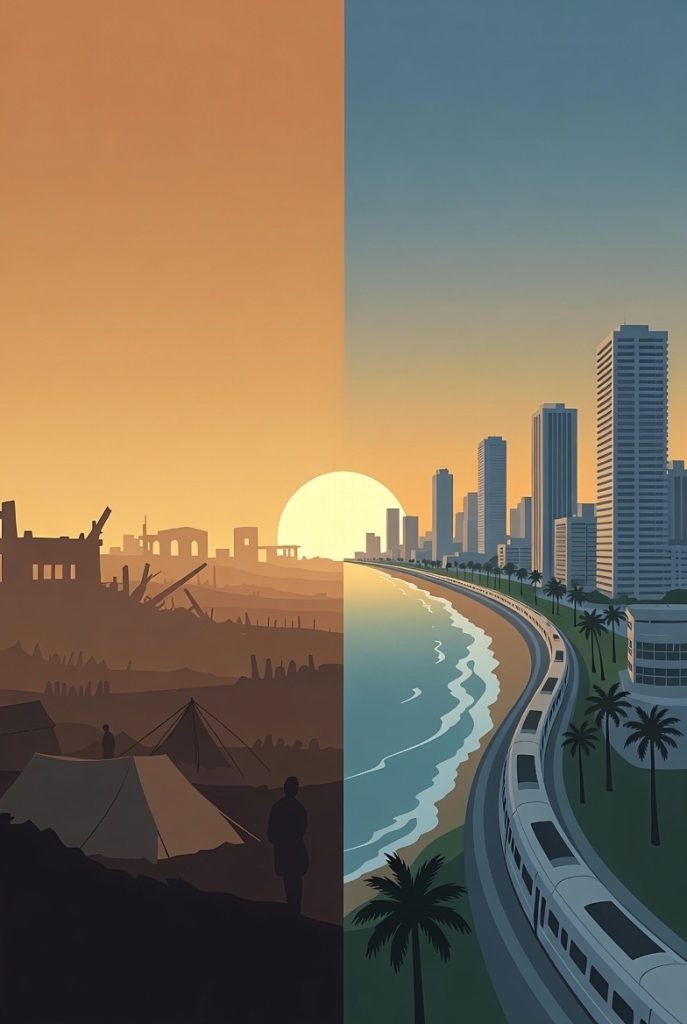
Project Sunrise is a U.S.-backed plan drafted in late 2025 by Jared Kushner and Steve Witkoff to rebuild war-torn Gaza into a modern high-tech coastal metropolis over 10-20 years. The $112 billion proposal includes luxury resorts, AI-powered smart cities, high-speed rail, beachfront hotels along a “Gaza Riviera,” and advanced infrastructure to shift from poverty to prosperity. The U.S. would anchor funding with around $60 billion in grants and loans, seeking additional investment from Gulf states and others. Implementation requires Hamas to fully disarm and demilitize, plus progress on ceasefire phase two with hostage releases and Israeli withdrawal. Supporters see it as a path to economic growth, jobs, and regional stability, while critics call it neo-colonial, warning of potential Palestinian displacement and prioritizing real estate profits over local rights. As of late December 2025, the plan remains in the proposal stage with no firm commitments.
Long Version
Project Sunrise: A Bold U.S.-Backed Proposal to Rebuild War-Torn Gaza
In the aftermath of prolonged conflict in the Middle East, a groundbreaking postwar reconstruction plan has emerged, aiming to transform Gaza from a zone of rubble and poverty into a futuristic high-tech metropolis. Dubbed Project Sunrise, this U.S.-backed proposal, drafted in late 2025 by Jared Kushner and Steve Witkoff, envisions a coastal development featuring luxury resorts, AI-powered infrastructure, high-speed rail, and smart cities over a 10- to 20-year timeline. Estimated at $112 billion initially—with the U.S. anchoring roughly $60 billion in grants and loans—the plan is being pitched to Gulf states and other donor countries, but only contingent on Hamas fully disarming and demilitarizing. While proponents hail it as a path to economic growth and prosperity, critics decry it as neo-colonial, potentially risking displacement and prioritizing real estate investment over Palestinian rights.
Background and Origin of the Plan
Project Sunrise arises from the Trump administration’s efforts to address the Gaza ceasefire and postwar peace process. Following a fragile truce in early October 2025, the proposal was developed over 45 days by Kushner, a former senior advisor, and Witkoff, a real estate developer serving as Middle East envoy. Presented in a 32-page PowerPoint labeled “sensitive but unclassified,” it builds on earlier ideas for turning the war-torn enclave into a Middle East Riviera, emphasizing urban development and infrastructure rebuilding. The plan draws from consultations with Israeli officials, private contractors, and regional stakeholders, including Qatar, Egypt, and Turkey, amid ongoing humanitarian aid challenges in the region.
The blueprint addresses Gaza’s devastation, including unexploded bombs, tunnel networks, and widespread destruction, by proposing a phased approach to clear rubble and establish temporary shelters and medical centers. It positions the U.S. as a key player in the peace process, leveraging its influence to foster development and investment in a historically aid-dependent area plagued by poverty. To enhance feasibility, the plan incorporates lessons from past reconstruction efforts in conflict zones, adapting them to Gaza’s unique geopolitical constraints and emphasizing rapid deployment of interim solutions to stabilize the population.
Detailed Overview of the Reconstruction Proposal
At its core, Project Sunrise seeks to rebuild Gaza into a smart city and tech utopia, integrating advanced technologies for sustainable growth. The plan divides the territory into phases: starting in the south with New Rafah as the seat of government, incorporating over 100,000 housing units, schools, and medical facilities; moving to Khan Younis and central refugee camps; and culminating in Gaza City as a high-tech hub.
Key elements include:
- Coastal and Urban Development: Monetization of about 70% of the coastline to create beachfront hotels, luxury resorts, and a Gaza Riviera, transforming the area into a prosperous metropolis. This involves zoning for mixed-use developments that blend residential, commercial, and recreational spaces to maximize land efficiency.
- High-Tech Infrastructure: AI-powered smart grids for energy management, high-speed rail connecting key areas for efficient transportation, and an innovation lab to guide policymaking through a Chief Digital Office. These features aim to incorporate renewable energy sources and data-driven urban planning to reduce environmental impact.
- Economic and Social Features: Modern housing options ranging from affordable units to high-rise apartments, cultural centers to preserve heritage, and self-funding mechanisms to shift from aid reliance to prosperity, with projections of over $55 billion in returns from real estate and infrastructure starting around year 10.
This futuristic vision aims to move residents “from tents to penthouses,” emphasizing economic growth through comprehensive urban planning. However, it leaves open questions about interim housing for Gaza’s approximately 2 million displaced residents during the rebuild, with suggestions for modular temporary structures to minimize disruption.
Funding, Investment, and Economic Model
The total cost is pegged at $112.1 billion over the initial 10 years, with the U.S. committing as the anchor investor through $41.9 billion in non-repayable grants and $15.2 billion in debt guarantees—about 20% of the overall funding. Additional contributions are sought from Gulf states, the World Bank, and private investors, with the plan designed to become partially self-funding through coastline development and monetization.
Proponents argue this model reduces long-term aid dependencies, fostering regional stability and U.S. business opportunities in tech and real estate. To enhance the economic framework, the proposal includes public-private partnerships that incentivize innovation, such as tax breaks for tech firms establishing operations in the new smart cities. Yet, critics warn of a potential debt trap, where loans and guarantees burden future generations without direct taxpayer returns, prioritizing elite investors over equitable growth.
Conditions and Prerequisites for Implementation
Central to Project Sunrise is the requirement for Hamas disarmament and demilitarization, including the decommissioning of weapons and tunnel networks. The plan ties into the Gaza ceasefire’s phase two, which demands hostage returns, Israeli withdrawals, and an interim non-Hamas authority backed by an international force. Without these, U.S. officials acknowledge the proposal may remain conceptual, highlighting the fragility of the peace process. Enhancing this aspect, the plan outlines verification mechanisms, such as third-party monitoring, to ensure compliance and build trust among stakeholders.
Potential Benefits and Pathways to Prosperity
If realized, the plan could catalyze economic growth, turning Gaza from a war-torn enclave into a hub of innovation and tourism. Advocates point to improved infrastructure, humanitarian aid integration, and job creation in high-tech sectors, potentially alleviating poverty and promoting prosperity. It aligns with broader Middle East development goals, offering indirect returns through stability and reduced conflict. Further benefits include enhanced connectivity via high-speed rail, which could facilitate trade with neighboring regions, and AI-driven systems for better resource allocation in water and energy management.
Criticisms and Controversies
Despite its ambitions, Project Sunrise faces significant controversy. Detractors label it neo-colonial, arguing it risks ethnic cleansing by displacing Palestinians during reconstruction without clear relocation plans. Palestinian voices and analysts criticize the focus on luxury resorts and tech utopia over immediate rights and needs, viewing it as prioritizing investment for connected figures like Kushner. Some see it as detached from reality, given ongoing resistance to demilitarization and the plan’s dependence on uncertain donor commitments. To address these concerns, enhancements could involve greater Palestinian input in planning phases to ensure cultural sensitivity and equitable land distribution.
Stakeholder Perspectives
The proposal has been shared with Gulf states like Qatar, Egypt, and Turkey, as well as potential private backers. While some regional actors express interest in stability, others remain skeptical. Palestinian reactions vary, with concerns over displacement dominating discussions. The Trump administration frames it as a positive step, but critics in media and policy circles highlight biases in favoring investors. Enhancing transparency, the plan could benefit from inclusive forums where all parties, including local communities, contribute to refining the blueprint.
Current Status and Future Outlook
As of December 29, 2025, Project Sunrise remains in the pitching phase, with no formal commitments or implementation underway. Tied to the ceasefire’s progress, its success hinges on political breakthroughs. While it offers a visionary roadmap for Gaza’s future, the plan’s viability amid controversy underscores the complexities of postwar reconstruction in the Middle East. Looking ahead, potential adaptations could include scalable pilots in less contested areas to demonstrate proof of concept and build momentum.
In summary, Project Sunrise represents a high-stakes gamble on development to achieve lasting peace, balancing innovation with the harsh realities of conflict and governance. By addressing both opportunities and challenges head-on, it could serve as a model for transforming other conflict-affected regions, provided it incorporates robust safeguards for human rights and sustainability.