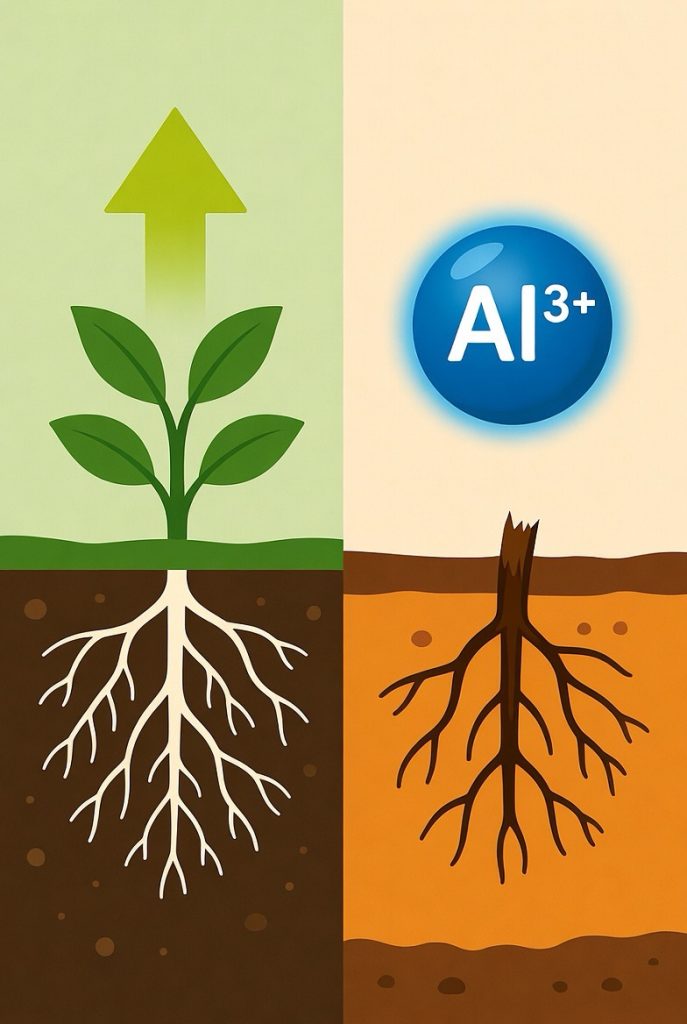
Soluble aluminum is rising in global soils as acid rain and synthetic fertilizers lower soil pH below 5.5, turning harmless aluminum into toxic Al³⁺ ions. This aluminum toxicity mainly affects acid soils, covering about 30% of the planet’s land and half of potential farmland. Toxic Al³⁺ damages plant roots by stunting growth, blocking cell division, and causing nutrient deficiencies, especially phosphorus deficiency. It reduces nutrient uptake, triggers plant stress, and cuts crop yields significantly in tropical regions. Key causes include acidic precipitation from pollution and ammonium-based fertilizers that leach base cations and weaken soil buffering capacity. Plants fight back by releasing organic acids like malate to neutralize Al³⁺ in the rhizosphere, while some species act as Al hyperaccumulators. Effective fixes include liming with dolomitic limestone to raise pH, adding organic matter, using tolerant crop varieties, and cutting emissions to curb acid rain. Addressing this issue is vital for maintaining soil fertility and sustainable food production.
Long Version
Rising Soluble Aluminum in Global Soils: Causes, Impacts, and Mitigation
In an era of intensifying agricultural practices and environmental changes, soluble aluminum is emerging as a significant threat to soil health worldwide. As soil pH drops below 5.5 due to factors like acid rain and synthetic fertilizers, aluminum transitions from inert forms to toxic soluble Al, particularly Al³⁺, disrupting ecosystems and agriculture. This phenomenon, driven by anthropogenic factors such as environmental pollution and acidic precipitation, affects acid soils that cover approximately 30% of the Earth’s land surface and up to 50% of potential arable land. Understanding aluminum toxicity is crucial for maintaining soil fertility and ensuring sustainable crop yield.
Causes of Soil Acidification and Increasing Soluble Aluminum
Soil acidification occurs naturally through processes like organic matter decomposition and mineral weathering, but human activities accelerate it significantly. Acid rain, resulting from emissions of sulfur dioxide and nitrogen oxides from fossil fuel combustion, deposits acidic precipitation that lowers soil pH and enhances aluminum solubility. Similarly, synthetic fertilizers, especially ammonium-based fertilizers, contribute to acidification by releasing protons during nitrification, further reducing soil pH and mobilizing exchangeable aluminum from soil particles.
These factors have led to a notable increase in soluble Al levels globally. In tropical and subtropical regions, where acid soils predominate, anthropogenic factors exacerbate the issue, leaching base cations like calcium and magnesium, which diminishes cation exchange capacity (CEC) and soil buffering capacity. This makes soils more susceptible to pH fluctuations, allowing stable aluminum compounds such as gibbsite and Al(OH)₃ to dissolve into toxic Al³⁺ ions. In regions affected by industrial pollution, environmental pollution has amplified aluminum release, turning once-stable soils into hotspots for phytotoxicity.
Mechanisms of Aluminum Toxicity
At the core of aluminum toxicity is its behavior in acid soils, where pH below 5.5 increases the solubility of Al³⁺, the most rhizotoxic form. Soluble Al exists primarily as Al³⁺ in highly acidic conditions, though it can hydrolyze into other species. This ion binds to negatively charged sites in the rhizosphere—the soil zone directly influenced by root activity—disrupting cell wall structure and plasma membrane function.
Exchangeable aluminum, adsorbed on soil colloids, readily enters the soil solution, reducing CEC by displacing base cations and weakening soil buffering capacity. In plants, Al³⁺ interferes with cellular processes, including DNA replication and enzyme activity, while generating reactive oxygen species that induce oxidative stress. Nutrient uptake is severely impaired as Al³⁺ precipitates with phosphorus, leading to phosphorus deficiency and reduced bioavailability of essential elements. The rhizosphere becomes particularly vulnerable, where increased Al³⁺ activity inhibits proton fluxes and alters membrane potential, exacerbating plant stress. Bioavailability of Al depends heavily on these dynamics, though organic acids in the soil can sometimes form complexes that temporarily reduce toxicity.
Effects on Plants, Agriculture, and Ecosystems
The impacts of aluminum toxicity are profound, beginning with root growth inhibition. Al³⁺ targets the root apex, causing rapid arrest of cell division and suppression of lateral roots. This stunts overall root development, severely limiting water and nutrient uptake, and leads to visible phytotoxicity symptoms such as root browning, swelling, and necrosis.
Plants experience widespread nutrient deficiency, particularly phosphorus deficiency, as Al³⁺ forms insoluble complexes that block vital nutrients, often inducing secondary deficiencies in calcium, magnesium, and potassium. On a broader scale, plant stress from aluminum reduces crop yield by impairing photosynthesis, biomass accumulation, and metabolic efficiency. In acid soils, this toxicity often compounds with other stresses, further degrading soil fertility.
Aluminum toxicity significantly affects major crops in tropical and subtropical regions, causing substantial yield losses in sensitive species and contributing to long-term food security challenges. Environmental pollution amplifies these effects, with acid rain leaching nutrients and altering ecosystem dynamics. Certain plants act as Al hyperaccumulators, tolerating high levels without harm, while others suffer, leading to shifts in biodiversity and reduced ecosystem resilience.
Plant Tolerance and Adaptation Mechanisms
Plants have evolved sophisticated strategies to cope with aluminum toxicity, generally divided into exclusion and internal tolerance mechanisms. Exclusion involves root exudation of organic acids—such as malate, citrate, and oxalate—into the rhizosphere. These acids chelate Al³⁺ into non-toxic complexes and locally raise pH, precipitating Al as insoluble Al(OH)₃ or gibbsite. The malate transporter, encoded by the ALMT1 gene, plays a central role; in tolerant species like certain wheat varieties, Al-activated ALMT1 facilitates malate release, significantly reducing soluble Al bioavailability and alleviating root growth inhibition.
Internal tolerance includes sequestering Al in vacuoles or binding it in cell walls, a trait prominent in Al hyperaccumulators such as tea and hydrangea. Genetic adaptations enhance citrate release through transporters like MATE, while robust antioxidant systems combat oxidative plant stress. These mechanisms improve nutrient uptake by countering phosphorus deficiency and help maintain CEC through better base cation retention. In natural ecosystems, mycorrhizal fungi often assist by immobilizing Al in the rhizosphere, further enhancing soil fertility and plant resilience.
Mitigation Strategies for Acid Soils
Effective management of aluminum toxicity focuses on restoring soil pH and buffering capacity. Liming, using materials such as dolomitic limestone, supplies base cations (calcium and magnesium) to displace exchangeable aluminum, precipitate it as insoluble Al(OH)₃, and increase CEC. This raises pH above 5.5, dramatically reducing soluble Al and improving nutrient bioavailability, soil fertility, and crop yield.
Additional approaches include incorporating organic matter to complex Al³⁺ with naturally occurring organic acids, thereby lowering phytotoxicity. Ammonium-based fertilizers should be applied cautiously, with regular pH monitoring to prevent further acidification. Emerging amendments like biochar show promise by adsorbing Al and enhancing soil buffering capacity through their alkaline nature.
Breeding and genetic improvement programs develop tolerant varieties by incorporating traits like enhanced ALMT1 gene expression or stronger malate transporter activity. Al hyperaccumulators can be strategically included in crop rotations for natural phytoremediation. Reducing emissions that cause acid precipitation remains critical for long-term prevention of environmental pollution and further rises in soluble Al.
Integrated strategies—combining liming, organic amendments, tolerant varieties, and careful fertilizer management—provide the most effective and sustainable defense against aluminum toxicity.
Future Considerations
As global soils continue to face escalating acidification from synthetic fertilizers and acid rain, addressing soluble aluminum toxicity is essential for preserving soil fertility and supporting reliable crop yield. By applying scientific understanding of mechanisms like ALMT1 gene function and rhizosphere dynamics, alongside practical mitigations such as dolomitic limestone application and organic acid exudation enhancement, farmers and land managers can significantly reduce plant stress and nutrient deficiency. Continued research into Al hyperaccumulators, improved soil buffering capacity, and innovative amendments will yield further solutions, ensuring resilient agriculture and healthy ecosystems in the face of ongoing environmental pressures. Prioritizing these measures promotes sustainable land use and safeguards productivity against the growing challenge of aluminum phytotoxicity.