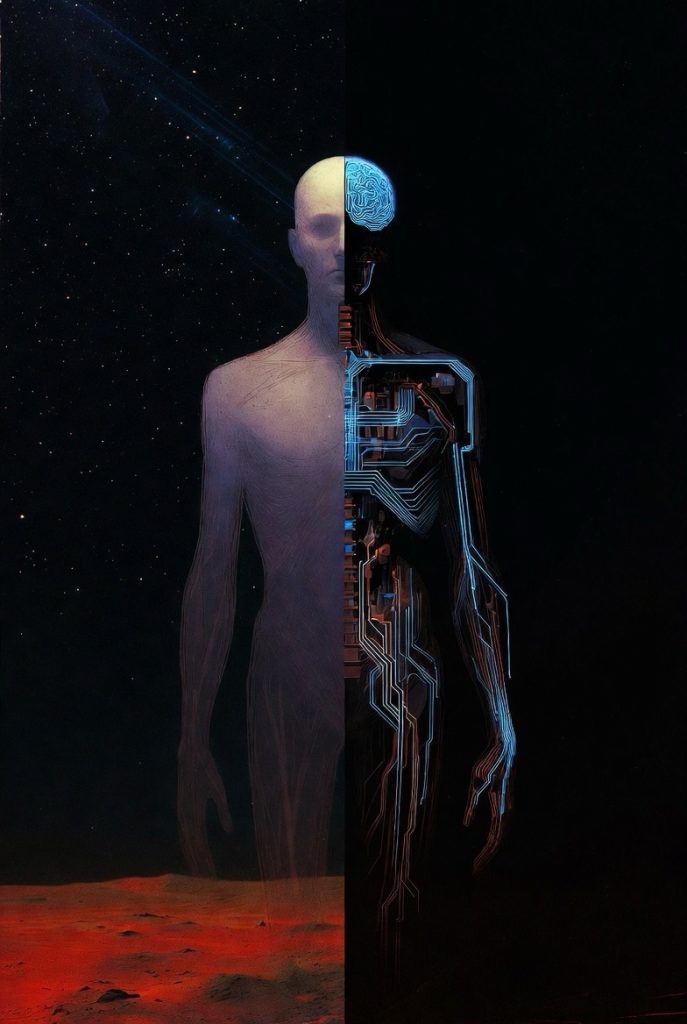
As humanity establishes isolated colonies in space, human evolution could diverge dramatically over 100,000 years. Natural selection in low gravity might favor taller, slimmer bodies with less muscle and bone density, while cosmic radiation could drive adaptations like enhanced DNA repair, darker skin, or better resistance to mutations and cellular aging. Microgravity causes rapid bone loss (1-2% per month) and muscle atrophy, potentially leading to evolutionary changes if unmitigated. Microbiome shifts and activated “dark genome” regions add further pressures. However, technology may outpace biology: advanced brain-machine interfaces enable thought-controlled devices, restoring movement or speech in impaired individuals and paving the way for human-machine merging, enhanced cognition, and transhumanism. Earth’s rapid adaptations, like light skin or lactose tolerance in millennia, show change is possible quickly. In space colonies, genetic engineering and cyborg enhancements could dominate, creating hybrid humans blending biology and tech—redefining our species while expanding across the solar system.
Long Version
The Future of Human Evolution in Isolated Space Colonies
As humanity ventures beyond Earth, establishing isolated colonies on other worlds or in orbital habitats, the trajectory of human evolution stands at a pivotal crossroads. Over timescales spanning 100,000 years or more, natural selection could drive profound biological adaptations to harsh space environments, including lower gravity and intense cosmic radiation. However, rapid advancements in technology, such as brain-machine interfaces, may outpace genetic changes, leading to a cyborg-like merging of humans and machines that redefines cognition, communication, and even our species’ identity. This article explores these dynamics, drawing on evolutionary biology, space science, and neurotechnology to provide a thorough examination of potential human transformations, incorporating the latest insights from ongoing research.
Biological Adaptations Through Natural Selection in Space
In the vacuum of space, isolated colonies would face evolutionary pressures unlike any on Earth, potentially leading to divergent human populations via natural selection. Lower gravity environments, such as those on Mars or lunar outposts, might favor taller, slimmer builds over generations. Without Earth’s full gravitational pull, bodies could elongate, with reduced need for robust skeletal support, echoing how isolated island populations on Earth have evolved distinct phenotypes. This phenotypic adaptation could arise from positive selection on genes influencing growth hormones and body proportions, allowing colonists to navigate low-gravity terrains more efficiently.
Cosmic radiation, including galactic cosmic rays and ionizing radiation, poses another major challenge, bombarding DNA and increasing mutation rates. Over millennia, natural selection might enhance DNA repair mechanisms, selecting for individuals with superior genomic adaptation to mitigate damage. For instance, populations exposed to unshielded radiation could evolve darker skin pigmentation to better protect against ultraviolet and other harmful rays, similar to how equatorial humans developed melanin-rich skin on Earth. Enhanced resistance to DNA damage might also involve hypomethylation or other epigenetic changes, fostering resilience in embryo development and preimplantation stages. Recent studies indicate that cosmic rays can accelerate cellular aging processes, inducing mutations that could drive evolutionary changes, while also posing risks like increased cancer incidence and cognitive impairments such as anxiety, memory loss, and attention deficits. These effects highlight the dual role of radiation as both a destructive force and a potential catalyst for rapid genetic shifts in small, isolated groups.
Microbiome changes would further complicate adaptation. Human bodies are ecosystems intertwined with Earth’s microbial life, and space’s sterile conditions could disrupt biofilms and gut flora, leading to altered immune responses and metabolic shifts. Research shows that microgravity can make certain bacteria more virulent and antibiotic-resistant, potentially selecting for human immune systems better equipped to handle these threats. In rotating habitats designed to simulate gravity, selective pressures might stabilize these microbial communities, but isolated colonies could see rapid genomic divergence, much like Darwin’s finches on the Galápagos. Early human development phases, from fertilization to infancy, may prove critical for embedding these adaptations, potentially accelerating evolution in controlled environments. Additionally, spaceflight has been found to activate previously dormant parts of the genome, the so-called ‘dark genome,’ which could introduce novel traits or exacerbate aging-related issues.
The Toll of Microgravity: Bone Density Loss, Muscle Atrophy, and Long-Term Effects
Microgravity’s immediate effects on the human body are well-documented from space missions, providing clues to potential evolutionary drivers if unmitigated. Astronauts experience bone density loss at rates of 1-2% per month, primarily in weight-bearing bones like the spine and hips, due to reduced mechanical loading. This leads to increased fracture risk and calcium release into the bloodstream, exacerbating issues like kidney stones. Muscle atrophy follows suit, with up to 30% loss in skeletal muscle mass and strength after just one month, as fibers shift from slow-twitch to fast-twitch types without gravitational resistance.
Over generations, if colonies rely on artificial gravity or countermeasures like exercise regimens, natural selection might favor individuals with innate resistance to these degradations—perhaps through genetic variants enhancing bone remodeling or muscle retention. However, in persistent microgravity, adaptations could include slimmer limbs and reduced muscle bulk to conserve energy, altering overall physiology. Cardiovascular deconditioning and sensorimotor changes, such as balance disruptions, might also drive selection for more resilient neural pathways. Recent 2025 research emphasizes that microgravity accelerates stem cell aging, reducing their regenerative capacity and increasing DNA damage susceptibility, which could compound long-term health risks. Neural changes in microgravity, including alterations in brain plasticity, are being investigated for their potential to inform treatments for neurological disorders on Earth, while in space, they might necessitate adaptations for sustained cognitive function. Predictive AI models are now being developed to forecast psychophysiological responses in space analogs, aiding in the design of habitats that minimize these effects.
Accelerating Evolution: Brain-Machine Interfaces and the Path to Cyborg Humanity
While biological evolution unfolds slowly, technology could dominate, propelling humans toward transhumanism and human-AI symbiosis. Brain-machine interfaces (BMIs), or brain-computer interfaces (BCIs), are advancing rapidly. By late 2025, over a dozen individuals have received implants from leading companies, enabling thought control for tasks like cursor movement, communication in paralyzed individuals, and even controlling wheelchairs or smart home devices just days after surgery. Ongoing expansions include dual implants for enhanced functionality, such as restoring mobility in spinal cord injuries, and applications for conditions like ALS through synthesized speech generated from brain activity.
These neurotechnologies, including neural lace and neuroprosthetics, could facilitate human-machine merging, allowing direct thought-to-thought communication and bypassing biological limitations. In space colonies, BMIs might mitigate isolation by enabling telepathic networks, altering cognition beyond traditional biology. Deep brain stimulation (DBS) and similar tools could enhance adaptation to space stressors, fostering a cyborg era where artificial intelligence integrates seamlessly with human neural networks. 2025 advancements highlight trends toward better brain signal capture, implants for mental health treatments, and expanded clinical trials by multiple firms, including those focusing on inner speech detection for speech-impaired patients. Ethical concerns, including neuroethics and the singularity—where AI growth outpaces human control—loom large, raising questions about identity and autonomy in a future where minds and machines mesh more intimately.
Lessons from Earth’s Rapid Evolutionary Changes
Humanity’s past demonstrates evolution’s speed, supporting the feasibility of space adaptations. The SLC24A5 gene allele for lighter skin spread across Europe in under 10,000 years, adapting to lower sunlight levels for better vitamin D synthesis. Other examples include lactose tolerance mutations enabling dairy digestion in pastoral societies, and immunity-related changes like resistance to plagues via specific genetic variants. Recent accelerations, such as adaptations to high-altitude hypoxia in Tibetans or metabolic shifts from agricultural diets, show how environmental pressures can drive genetic mutations in mere millennia.
In space, similar rapid changes could occur under intensified selection, especially in small, isolated populations where genetic drift amplifies mutations. De novo genes, emerging anew rather than from existing ones, might enable quick responses to novel threats like radiation-induced damage. Cosmic rays have been theorized to influence evolutionary processes, potentially accelerating mutations and even shaping biological handedness through polarized radiation exposure.
Technology’s Dominance Over Genes: A New Paradigm
Ultimately, while natural selection could sculpt space-adapted humans, technology may overshadow genetics. Genetic engineering could preempt evolutionary needs, editing embryos for enhanced radiation resistance or microgravity tolerance. Transhumanist visions of cyborg enhancements—merging with AI for immortality or expanded cognition—suggest a future where biological constraints fade. In colonies, this human enhancement might create hybrid beings, blending organic evolution with engineered progress, potentially leading to speciation events across the solar system. Research into altering the human condition for deep space, such as through real-time biological monitoring and predictive algorithms, could enable astronauts to optimize their physiology dynamically.
Yet, challenges persist: ethical dilemmas around equity, the risk of over-reliance on tech, and unforeseen consequences like disrupted microbiomes or psychological strains in confined habitats. As autonomy increases in deep space missions, training for self-sustenance will be crucial, blending biological resilience with technological augmentation.
In summary, over 100,000 years, space colonies could forge new human forms through natural selection’s grind or technology’s swift blade. Whether taller, radiation-hardened biologists or cyborg intellects, our descendants may embody a profound symbiosis of genes and machines, expanding humanity’s reach while redefining its essence. This evolution, informed by Earth’s lessons and space’s trials, promises a resilient future—if we navigate its complexities wisely.