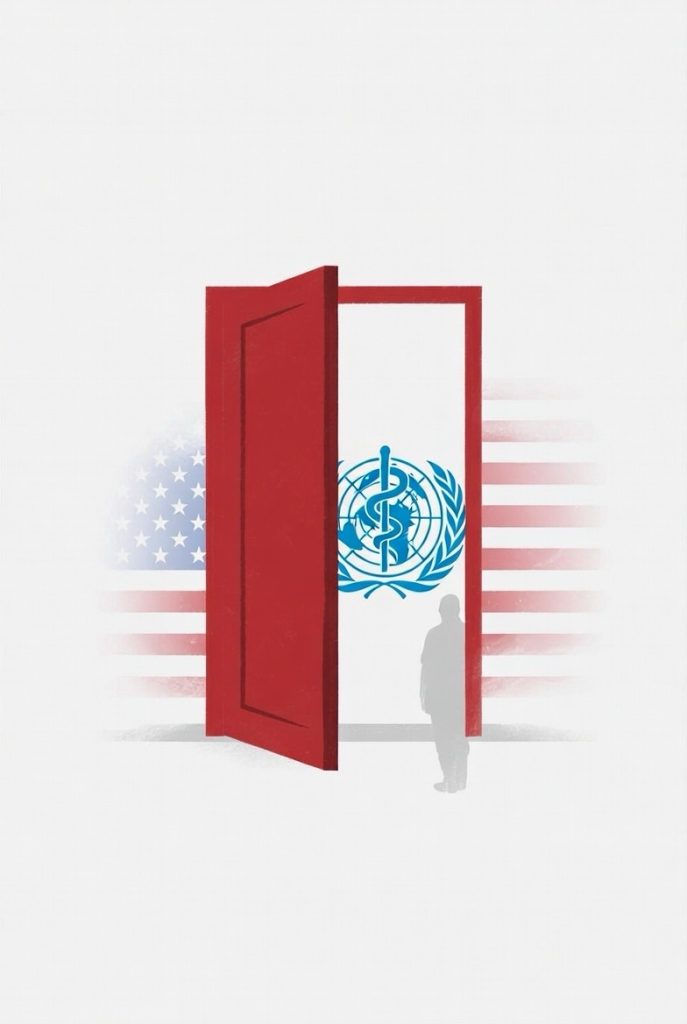
In January 2026, the United States formally withdrew from the World Health Organization, a move driven by the Trump administration’s criticisms of the agency’s COVID-19 response, perceived inefficiencies, and lack of accountability, aiming to redirect resources toward domestic priorities and selective bilateral partnerships. This US exit from WHO creates an 18% budget gap, forcing significant staff reductions of about 25% and straining global programs in disease surveillance, vaccine distribution, and emergency response. While supporters view the decision as reclaiming sovereignty and encouraging reform, critics warn of heightened global health risks, including weakened pandemic preparedness, fragmented AI ethics in health data, and challenges linking sustainability to disease patterns. The withdrawal highlights ongoing debates over multilateral cooperation versus national independence, with potential for future policy shifts or alternative alliances to address shared health threats worldwide.
Long Version
The US Withdrawal from WHO: Navigating a New Era in Global Health Governance
The United States’ formal departure from the World Health Organization in January 2026 represents a profound transformation in the framework of international health collaboration. This move, finalized after a year-long process initiated by the Trump administration, stems from deep-seated concerns over the agency’s effectiveness and alignment with American priorities. As the WHO confronts an 18% funding shortfall and implements substantial staff reductions, questions arise about the future of coordinated global responses to health crises. Proponents view this as an opportunity for more agile, US-centric health strategies, while detractors highlight potential vulnerabilities in worldwide disease control and equity. This in-depth exploration covers the historical foundations, driving factors, procedural details, economic consequences, health security risks, diverse reactions, and long-term prospects of the US exit from WHO, equipping you with a complete understanding to inform your perspective on this pivotal shift.
Tracing the Roots: The Evolving US-WHO Partnership
The relationship between the United States and the World Health Organization has been integral to global health advancements since the agency’s inception. Founded in 1948 under the United Nations umbrella, WHO aimed to build a healthier world through collective action, with the US as a key architect and contributor. American leadership and resources were instrumental in milestones like the eradication of smallpox in 1980 and near-elimination of polio, demonstrating the power of multilateral efforts.
For decades, the US provided the largest share of WHO’s funding, often exceeding 20% through mandatory assessed contributions and voluntary donations tailored to programs such as emergency response and vaccine distribution. This support facilitated critical functions, including setting health standards, coordinating research, and aiding low-income countries. However, strains emerged over time. The 2020 COVID-19 outbreak amplified criticisms, with the first Trump administration accusing WHO of inadequate transparency and bias in handling the pandemic’s origins. Although President Biden reinstated membership in 2021, emphasizing renewed commitment, underlying issues of reform, accountability, and value for investment lingered.
By 2025, following Trump’s re-election, the administration reactivated the withdrawal, framing it as essential for reclaiming control over health policy. This US WHO membership end echoes past tensions, such as debates during the Reagan era over perceived inefficiencies, but stands out for its timing amid rising geopolitical rivalries and technological shifts in health.
Core Motivations for the US Quitting WHO
The decision to pursue the Trump WHO withdrawal reflects a mix of ideological, operational, and strategic rationales. Central to the argument is WHO’s management of the COVID-19 crisis, where US officials claim the organization delayed declarations, overlooked early warnings, and failed to enforce accountability on member states. Health and Human Services leadership has pointed to this as evidence of systemic flaws, advocating for resources to be channeled into domestic innovations and selective international alliances.
Additional grievances include perceived bureaucratic inefficiencies and a lack of adaptability to modern challenges. Critics argue that WHO’s structure hinders rapid decision-making, with funds sometimes diluted across too many initiatives. In the context of 2026 trends, such as AI ethics in health data and sustainability linkages to disease patterns, the US contends that WHO’s approaches fall short of integrating cutting-edge American advancements. Fiscal prudence is another pillar: As the top donor, the US seeks to redirect billions toward national priorities like mental health services and opioid crisis mitigation, avoiding what it views as subsidizing an underperforming entity.
Balanced perspectives acknowledge WHO’s achievements and ongoing reforms, such as post-COVID audits enhancing surveillance. Supporters of continued membership stress that withdrawal overlooks the interdependent nature of health threats, potentially isolating the US from vital intelligence. Nonetheless, the reasons for US withdrawal from WHO resonate with those prioritizing sovereignty, positioning the exit as a corrective measure for perceived imbalances.
The Mechanics of Departure: How the US Exit from WHO Unfolded
The process of the US leaves WHO was methodical, adhering to the organization’s constitution. WHO membership allows withdrawal after providing one-year notice and settling financial arrears, a provision the US itself helped draft. On January 20, 2025—inauguration day—the administration issued formal notification via executive order, citing unresolved concerns from prior engagements.
Over the subsequent year, the US phased out involvement: Ceasing new contributions, withdrawing delegates from Geneva headquarters and regional offices, and transitioning joint projects to alternative frameworks. By January 2026, the separation was complete, though disputes persist over outstanding dues estimated at $260 million for 2024-2025 cycles. This US funding halt to WHO required careful disentanglement, including rerouting data flows for ongoing research and reallocating personnel.
Legally, the move complies with international norms, but it sets precedents for other nations. Comparisons to US exits from bodies like UNESCO in 2017 highlight patterns of selective engagement, where dissatisfaction leads to unilateral action. This structured US departure from WHO minimizes chaos but underscores the challenges of unwinding decades of integration.
Economic and Operational Fallout: Addressing the WHO Budget Gap
The financial repercussions of the WHO US withdrawal are immediate and far-reaching. The US historically accounted for about 18% of WHO’s budget, blending assessed dues—based on GDP—and voluntary funds for targeted areas. This loss creates a substantial deficit in the agency’s $6-7 billion biennial budget, compelling austerity measures.
In response, WHO has initiated significant staff cuts, reducing its workforce by approximately 25%, affecting around 2,100 positions from a total of 8,500. These reductions focus on administrative and support roles to safeguard frontline operations, but they inevitably strain capacity. WHO staff cuts from US withdrawal could delay program implementation, from outbreak investigations to health policy guidance.
Broader economic effects include potential shifts in donor dynamics. WHO must court alternatives, such as increased contributions from Europe, private philanthropies like the Gates Foundation, and emerging powers. This raises concerns about influence: Could heavier reliance on certain donors skew priorities? For the US, savings enable investments in bilateral aid, potentially yielding more direct benefits, though at the risk of duplicated efforts globally. Analyzing these changes reveals opportunities for efficiency but warns of short-term disruptions in resource allocation.
Heightened Global Health Risks and Program-Specific Impacts
The implications of US withdrawal from WHO extend deeply into health security, amplifying vulnerabilities in an interconnected world. WHO’s role in pandemic preparedness—coordinating alerts, vaccine equity, and response strategies—faces erosion without US expertise and funding. Experts caution that gaps in global health risks from US withdrawal could prolong future outbreaks, echoing lessons from Ebola where delays cost lives.
Specific programs bear the brunt: HIV funding impact from withdrawal threatens initiatives like PEPFAR, which overlapped with WHO efforts; reductions could slow progress toward ending AIDS as an epidemic. Vaccine distribution, including for childhood immunizations and emerging threats, might suffer from fragmented supply chains. Disease surveillance risks intensify, with systems like the Global Outbreak Alert and Response Network potentially under-resourced, hindering early detection.
In 2026, intersecting trends exacerbate these concerns. AI ethics in global health, vital for predictive modeling and data privacy, could fragment without unified standards. Sustainability challenges in global health, linking climate change to vector-borne illnesses, demand collaborative action that the US exit complicates. While the US plans independent advancements, such as AI-driven tools for domestic surveillance, the absence from WHO risks creating silos, disadvantaging resource-poor nations and indirectly affecting all.
Diverse Reactions: From International Outcry to Domestic Divisions
The announcement of the World Health Organization withdrawal triggered a spectrum of responses, illustrating its geopolitical ripples. Globally, allies like the European Union and Canada lamented the decision, urging reconsideration to maintain unity against shared threats. WHO Director-General Tedros Adhanom Ghebreyesus expressed disappointment, affirming the agency’s reform trajectory while highlighting the irreplaceable US role in past successes.
Developing countries, dependent on WHO for technical aid, voiced alarm over potential cutbacks in essential services. Expert views on withdrawal vary: Public health organizations like Johns Hopkins warn of diminished US influence, creating vacuums for nations like China to expand sway. Conversely, some analysts praise the move for pressuring WHO toward greater accountability.
In the US, public opinion on US WHO exit is polarized. Polls indicate support among those favoring reduced international spending, but opposition from medical communities emphasizing interconnected risks. State actions, such as California’s exploration of direct WHO collaborations, reflect federal divides. These reactions underscore the withdrawal’s role in broader debates on multilateralism, with calls for balanced approaches that preserve cooperation without full membership.
Looking Forward: Scenarios and Strategies in a Post-Withdrawal Landscape
The future implications of US WHO withdrawal hinge on adaptive strategies. For WHO, bridging the budget void involves diversifying funding and streamlining operations, potentially enhancing resilience. Areas like 2026 health trends post-withdrawal—integrating AI for ethics-driven innovations and sustainability for climate-health synergies—could evolve through new partnerships.
The US, meanwhile, pursues a recalibrated strategy: Bolstering entities like the CDC for global outreach and forging alliances outside WHO, such as with the G7 or Quad. Rejoining remains feasible; historical policy swings suggest future administrations could reverse course if benefits outweigh costs. Globally, this might catalyze reforms, fostering a more inclusive governance model.
Actionable takeaways include advocating for hybrid models—combining national strengths with selective international ties—and investing in domestic preparedness. By addressing pros like cost savings and cons like coordination gaps, stakeholders can mitigate downsides, ensuring health equity endures.
Synthesis: Balancing Independence and Interdependence in Global Health
The US quits WHO in 2026 challenges the status quo, prompting reflection on optimal paths for health security. From historical ties to current risks and future adaptations, this analysis reveals the trade-offs: Greater autonomy for the US, but potential fragmentation worldwide. Embracing evidence-based insights, readers can champion solutions that prioritize innovation, equity, and collaboration, turning this juncture into a catalyst for stronger global health systems.