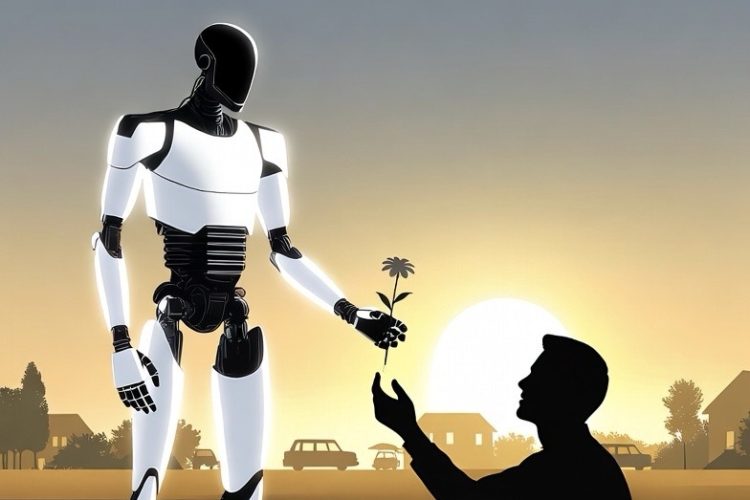
Elon Musk predicts a future of universal high income—not just basic income—driven by rapid advances in artificial intelligence and robotics. Through projects like Tesla’s Optimus humanoid robot, he envisions a post-scarcity world where automation handles most work, making jobs optional and eliminating poverty. This sustainable abundance would provide everyone with top-quality healthcare, housing, food, and transportation, reducing the need to save money. Musk expects this shift within 10–20 years as superintelligence boosts productivity dramatically. While mass unemployment may occur, he sees it leading to leisure and meaningful pursuits rather than hardship. Critics worry about inflation or loss of purpose, and experts like Ray Dalio stress the need for smart policies combining redistribution with education and opportunity. Overall, Musk’s vision redefines capitalism, turning scarcity into optional choice and unlocking human potential through ethical AI development and financial literacy.
Long Version
Elon Musk’s Vision: Universal High Income and the Dawn of an AI-Powered Abundance Economy
In a world increasingly shaped by rapid technological advancements, Elon Musk has emerged as a pivotal figure forecasting profound changes to our economic landscape. His recent assertions that “there will be universal high income (not merely basic income)” have sparked widespread debate, suggesting a future where automation and artificial intelligence (AI) eliminate scarcity and redefine capitalism. Musk envisions a society of sustainable abundance, where everyone enjoys the best medical care, food, home, transport, and more, rendering traditional notions of saving money obsolete.
The Origins of Musk’s Prediction
Elon Musk’s proclamation stems from his deep involvement in AI and robotics through companies like Tesla and xAI. He argues that as superintelligence evolves, humanoid robots such as the Optimus robot will handle mundane tasks, leading to an era of post-scarcity. In interviews and public statements, Musk has elaborated that AI-driven automation will create such profound productivity gains that mass unemployment becomes inevitable, but in a positive sense—work will become optional, transforming the future economy into one of universal prosperity. This isn’t just speculation; Musk points to tangible progress, like Optimus robots already navigating labs autonomously, charging themselves, and performing tasks on uneven terrain without visual input.
Musk differentiates universal high income from universal basic income (UBI), emphasizing that the former implies not just survival-level support but genuine affluence for all. He predicts this shift could occur within 10 to 20 years, driven by robotics and AI eliminating poverty and enabling poverty elimination on a global scale. For instance, Tesla aims to deploy legions of Optimus robots for internal use by next year, scaling to high production for other companies by 2026.
AI and Robotics: The Engines of Change
At the heart of this transformation is artificial intelligence paired with advanced robotics. Musk foresees humanoid robots outnumbering humans, with each person potentially owning personal assistants akin to Star Wars’ R2-D2 and C-3PO. These machines, powered by superintelligence, will handle industrial production, providing goods and services in abundance. Automation will disrupt traditional jobs, leading to mass unemployment, but Musk views this as a gateway to leisure and optional pursuits rather than hardship.
The Optimus robot exemplifies this: demonstrations show it dancing at real speed, walking mulch-covered grounds blindly using onboard sensors, and integrating vision for obstacle avoidance. Such advancements signal a future where robotics not only boosts efficiency but fundamentally alters capitalism by decoupling income from labor. In Musk’s words, “no scarcity, except that which we define to be scarce.”
To enhance understanding, consider the broader mechanics: AI systems could optimize resource allocation globally, predicting needs and automating supply chains to minimize waste. This would extend beyond manufacturing to agriculture, healthcare, and education, where robots perform precise surgeries, harvest crops efficiently, or personalize learning experiences, further amplifying abundance.
Economic and Societal Implications
The advent of universal high income could reshape the future economy, fostering sustainable abundance where resources are plentiful and accessible. However, this raises questions about unemployment and financial literacy. As automation displaces workers, societies must adapt, potentially through education on managing newfound wealth and pursuing meaningful activities to avoid a “crisis of meaning.” Musk warns of risks, including a 10-20% chance of AI-related annihilation, but highlights upsides like optional work and unlimited goods.
Critics argue that universal high income might inflate prices or discourage innovation, echoing concerns in discussions where observers note “universally high prices” could undermine benefits. Yet, proponents see it as a tool for poverty elimination, aligning with broader debates on capitalism’s evolution in a post-scarcity world. Enhancing this perspective, economic models suggest that with AI managing production, costs could plummet due to near-zero marginal expenses for goods, countering inflation fears and enabling true equity.
Broader Perspectives and Policy Debates
Influential voices like Ray Dalio, the billionaire investor, have weighed in on related concepts. Dalio advocates for wealth redistribution policies amid AI’s rise, warning that universal basic income could harm if it diverts funds from education and productivity-enhancing investments. He calls for careful implementation to avoid pitfalls, emphasizing that true abundance requires empowering individuals through opportunity rather than handouts.
On the political front, there’s growing bipartisan effort around income support programs. Bills like the Guaranteed Income Pilot Program Act of 2023 aim to study monthly payments’ effects, with states like Kansas and pilots in cities debating their viability. Even under former President Donald Trump, discussions touched on economic relief, with some interpreting his tariff proposals as a backdoor to dividend-like payments, akin to Alaska’s sovereign wealth fund funding universal basic income-style dividends. Trump’s economic policies often emphasized growth over direct assistance, but allies like Musk have pushed UBI variants, highlighting potential cross-party alignment.
Financial literacy remains crucial in this context, as individuals navigate a world where traditional saving might wane, but informed decision-making ensures sustainable personal economies. To build on this, programs could include AI-driven financial advisors that simulate scenarios, teaching users about investment in a post-labor world.
Challenges and the Path Forward
While Musk’s optimism paints a utopian picture, challenges abound. Superintelligence could exacerbate inequalities if not managed equitably, and mass unemployment might strain social fabrics without adequate transitions. Bipartisan efforts in Congress and state legislatures are testing guaranteed income pilots, providing data on real-world impacts. Dalio’s cautionary notes underscore the need for balanced policies that boost productivity alongside redistribution.
To address these, international frameworks might emerge, regulating AI to ensure fair distribution of benefits. Ethical guidelines could prioritize human oversight in robotic systems, preventing misuse while maximizing societal gains. Education reforms, focusing on creativity and critical thinking, would prepare populations for a leisure-oriented society.
Ultimately, Musk’s vision of universal high income challenges us to rethink abundance in an AI-dominated era. As humanoid robots like Optimus proliferate and automation accelerates, the future economy could indeed eliminate poverty, but success hinges on ethical AI development, financial education, and collaborative policy-making. This paradigm shift offers a glimpse into a world of sustainable abundance, where humanity’s potential is unbound by scarcity, fostering innovation in arts, sciences, and exploration.