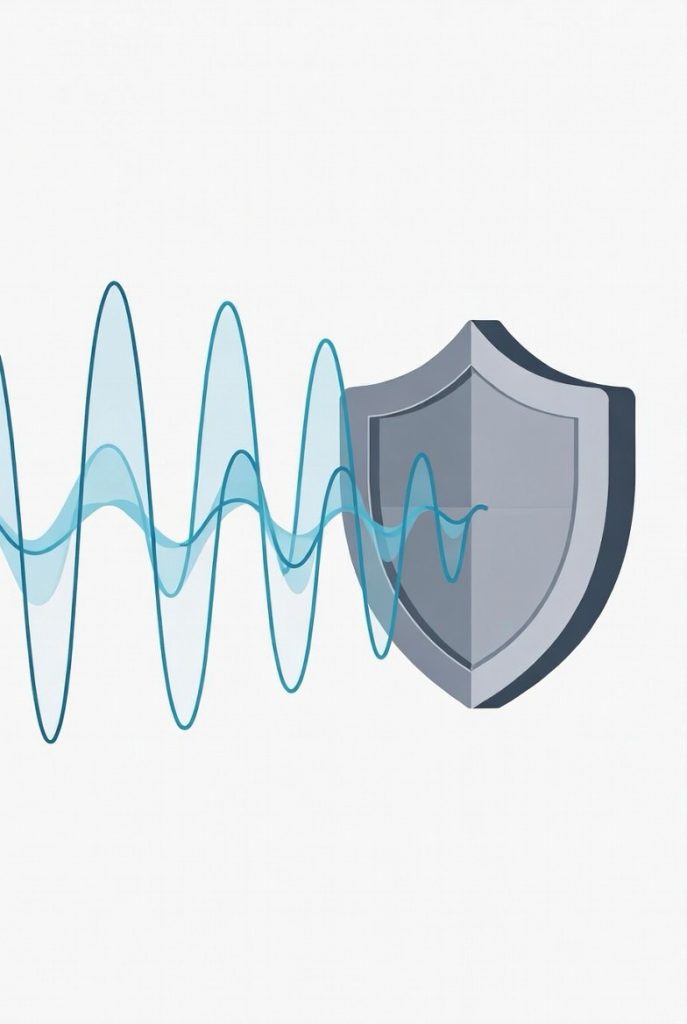
Electromagnetic radiation (EMR) from devices like cell phones, Wi-Fi, and power lines includes non-ionizing radiofrequency (RF) energy and ionizing types like X-rays. While high exposure can cause heating or DNA damage, long-term low-level health risks remain debated, with some studies noting possible oxidative stress or links to childhood leukemia. To protect yourself, follow three principles: limit time near sources, increase distance (intensity drops sharply farther away), and use shielding. Effective shields include Faraday cages (metal mesh or foil) for RF and wireless signals, mu-metal for low-frequency magnetic fields, lead or concrete for ionizing radiation, and advanced materials like MXene, conductive polymers, or carbon composites for strong attenuation. Practical steps: use wired connections, place routers far from living areas, apply shielding paint or fabrics, and avoid unproven gadget stickers. Prioritize verified methods to safely reduce exposure without giving up modern technology.
Long Version
Understanding and Blocking Electromagnetic Radiation: A Complete Guide to Protection
In our increasingly connected world, electromagnetic radiation (EMR) surrounds us, emanating from everything from power lines and wireless signals to medical devices and natural sources. Electromagnetic fields (EMF) encompass a broad spectrum, including both ionizing radiation—such as X-rays and gamma rays that can strip electrons from atoms—and non-ionizing radiation, like radiofrequency (RF) energy from cell phones and microwaves. While EMR is essential for modern technology, concerns about health risks, including potential links to oxidative stress and other biological effects, have driven interest in radiation shielding and exposure reduction strategies. This article explores the most effective ways to block EMR and similar forms of energy, drawing on scientific principles and materials science to provide a thorough resource for safeguarding health and electronics.
The Spectrum of Electromagnetic Radiation and Its Implications
Electromagnetic radiation spans from low-frequency EMF produced by household appliances to high-energy waves in medical imaging. Non-ionizing radiation, which includes RF energy and microwave frequencies, primarily causes thermal effects by heating tissues, but research indicates it can also trigger oxidative stress in cells, potentially altering antioxidant systems. Ionizing radiation, on the other hand, poses greater risks by damaging DNA, increasing the likelihood of cancer or other cellular mutations. Health risks from prolonged EMF exposure remain a topic of debate; while high-level exposures can lead to tissue heating or induced currents, low-level, long-term effects are not conclusively proven to cause adverse outcomes like cancer or reproductive issues. However, epidemiological studies have suggested weak associations with childhood leukemia from low-frequency magnetic fields, prompting precautionary measures.
A subset of individuals reports electro-hypersensitivity (EHS), experiencing symptoms like headaches, fatigue, and sleep disturbances attributed to EMF, though scientific evidence does not confirm a direct causal link—symptoms often persist even in blinded studies without actual exposure. Amid these concerns, understanding Schumann resonances—natural EMF pulses in Earth’s atmosphere around 7.83 Hz—highlights the contrast between beneficial environmental fields and man-made wireless signals, which some believe disrupt biological rhythms. Regulatory bodies set exposure limits, such as the Specific Absorption Rate (SAR), which measures RF energy absorbed by the body in watts per kilogram, with public limits at 1.6 W/kg in the U.S. to prevent heating effects.
To enhance protection strategies, it’s worth noting that individual susceptibility can vary based on factors like age, genetics, and overall health. For instance, children and pregnant individuals may require more stringent measures due to developing tissues being potentially more vulnerable to disruption. Additionally, emerging research explores how EMF interacts with other environmental stressors, such as pollutants, which could amplify effects through synergistic mechanisms.
Core Principles of Radiation Protection
Effective radiation protection hinges on three pillars: time, distance, and shielding. Minimizing exposure time reduces cumulative dose, while increasing distance from sources exponentially lowers intensity due to the inverse square law. Shielding, however, offers the most direct barrier, employing materials that achieve attenuation—the reduction in radiation intensity—through absorption or reflection. The absorption coefficient quantifies how much energy a material dissipates per unit distance, while shielding effectiveness (SE) measures overall performance in decibels (dB), with higher values indicating better blockage. For instance, a SE of 60 dB blocks 99.9999% of EMR, crucial for electromagnetic interference (EMI) mitigation in sensitive electronics.
These principles align with the ALARA (As Low As Reasonably Achievable) approach, emphasizing practical exposure reduction without eliminating technology’s benefits. For similar energy forms, like thermal infrared, reflective barriers apply analogous concepts, though acoustic or mechanical waves require different mass-based absorbers. Enhancing this foundation, practical implementation often involves layered defenses: combining passive shielding with active monitoring tools, such as EMF meters, to verify reductions and adjust as needed.
Materials and Techniques for Blocking EMR
The choice of materials depends on the radiation type. For non-ionizing RF energy and wireless signals, conductive metals excel at creating Faraday cages—enclosures that redistribute charges to cancel internal fields. Simple aluminum foil or mesh can form a basic Faraday cage, blocking signals from cell phones or Wi-Fi routers. Mu-metal, a nickel-iron alloy, is particularly effective against low-frequency magnetic fields, redirecting flux lines with high permeability.
Advanced wave-absorbing materials incorporate nanotechnology for superior performance. MXene, a two-dimensional carbide or nitride, offers dynamic EMI shielding through spray-coatable films that achieve over 99% attenuation by absorbing and reflecting waves, ideal for flexible electronics. Conductive polymers, such as polyaniline or PEDOT, provide lightweight, corrosion-resistant options when blended into composites. Carbon-based composites, infused with graphene or nanotubes, enhance conductivity and mechanical strength, yielding SE values up to 61 dB in polyethylene matrices while also improving thermal conductivity. Metal-infused composites, like those with silver or copper weaves, are used in anti-radiation technology for fabrics, curtains, or paints that shield homes from external EMR.
For ionizing radiation, denser barriers are essential. Lead sheets or concrete walls provide robust protection by scattering high-energy photons, with water also serving as an effective shield in nuclear settings. Biomass-derived composites, such as wood-polymer hybrids, represent eco-friendly alternatives for EMI shielding, leveraging natural fibers for sustainable attenuation. To further enhance durability, recent developments focus on multifunctional composites that not only block EMR but also offer self-healing properties or integration with sensors for real-time effectiveness monitoring.
Practical Applications and Home Strategies
In everyday scenarios, blocking EMR involves targeted interventions. For wireless signals from routers or smart devices, position them away from living areas and use wired alternatives to cut exposure. Apply shielding paints or metal grids on walls to create EMI-protected zones, reducing penetration from nearby cell towers. Window films with metallic coatings block up to 99% of RF energy while allowing light through. For personal devices, hands-free kits lower SAR by increasing distance, though beware of unproven “shielding” accessories that may inadvertently boost emissions.
In professional settings, like labs or data centers, mu-metal enclosures protect against magnetic interference, while MXene-based composites safeguard advanced circuitry. For broader EMI control, conductive polymers in wearable anti-radiation technology offer portable solutions, such as clothing that attenuates RF waves. Children, with thinner skulls, may face higher relative risks, so guidelines recommend limiting their device use. Enhancing home setups, consider zoning: designate low-EMF areas for sleeping or relaxation by rerouting wiring and using grounded outlets to minimize stray fields.
Advanced Insights into Shielding Effectiveness
Delving deeper, attenuation relies on material properties like conductivity and thickness. The absorption coefficient for a given frequency determines how quickly waves decay; for example, in MXene films, it enables tunable shielding by adjusting layers. Composites optimize this through filler dispersion—carbon-based variants excel in broadband absorption, covering multiple frequencies. Shielding effectiveness integrates reflection loss (from impedance mismatch) and absorption loss, with SE formulas accounting for multiple internal reflections in thin films. Emerging research on polymer/MXene hybrids pushes boundaries, achieving high SE with low filler content for lightweight applications.
International standards ensure devices meet safe SAR thresholds, with public exposure limits far below levels causing harm. Ongoing studies monitor potential synergic effects with other risks, but current evidence supports that proper shielding minimizes any unconfirmed health risks. To advance understanding, computational modeling tools simulate EMR interactions with materials, allowing custom designs for specific frequencies or environments.
Final Thoughts on Safeguarding Against EMR
Blocking electromagnetic radiation effectively combines science-backed materials like Faraday cages, mu-metal, MXene, conductive polymers, and composites with simple habits for exposure reduction. By addressing both ionizing and non-ionizing sources, individuals can mitigate health risks, alleviate EHS concerns, and protect against EMI without forgoing technology’s advantages. Always prioritize verified methods over unproven products, consulting reliable resources for tailored advice. This balanced approach fosters a safer electromagnetic environment, grounded in factual accuracy and practical insights.