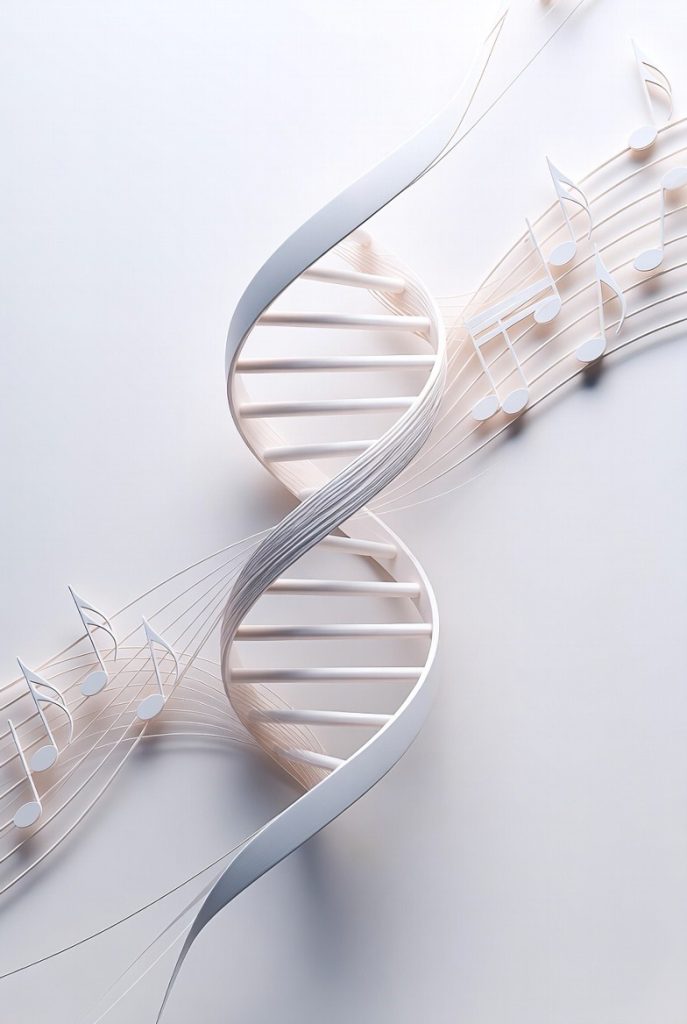
Susumu Ohno, a pioneering geneticist, bridged biology and music by exploring the patterns of repetition in DNA sequences, which mirror musical compositions. In his 1986 paper, he introduced the concept of DNA sonification, converting genetic codes into sound, revealing structural similarities between genetics and music. Modern interpretations of this idea extend to sound healing, with claims that frequencies like 528 Hz can influence DNA repair, reduce oxidative stress, and affect epigenetics. Though research shows some benefits of sound frequencies in biological processes, direct evidence linking 528 Hz to DNA repair remains limited. Ohno’s work continues to inspire studies on how vibrations may impact genetic expression and health, blending scientific inquiry with speculative healing practices.
Long Version
The Intersection of DNA and Music: Susumu Ohno’s Legacy and Modern Sound Healing Claims
In the fascinating realm where biology meets art, the work of geneticist Susumu Ohno stands as a pioneering bridge. His 1986 paper explored how DNA sequences, with their inherent repetition and structure, mirror the principles of musical composition, sparking interest in DNA sonification. This concept has since evolved into broader discussions on sound, frequency, and healing, including claims that specific vibrations like 528 Hz can influence DNA repair, reduce oxidative stress, and affect epigenetics. While Ohno’s research was rooted in genetics and cellular processes, contemporary interpretations extend to bioacoustics, cymatics, and restorative frequencies, offering insights into how vibration and resonance might interact with our genetic blueprint.
Susumu Ohno: A Visionary in Genetics and Beyond
Susumu Ohno (1928–2000) was a Japanese-American geneticist renowned for his contributions to evolutionary biology and molecular genetics. He is credited with coining the term “junk DNA” in a 1972 letter, referring to non-coding sequences that make up much of the genome, challenging earlier views of genetic efficiency. Ohno also advanced the 2R hypothesis, proposing that genome duplications—specifically two rounds of whole-genome duplication early in vertebrate evolution—drove complexity through gene redundancy and diversification. His work on X-inactivation explained how one X chromosome in females is silenced to balance gene expression with males, a process involving epigenetic mechanisms like DNA methylation and histone modification.
Ohno’s curiosity extended beyond traditional genetics. In the 1980s, he began drawing parallels between DNA and music, viewing both as governed by patterns of repetitious recurrence. This culminated in his 1986 paper, “The all pervasive principle of repetitious recurrence governs not only coding sequence construction but also human endeavor in musical composition,” published in Immunogenetics. Here, Ohno argued that the redundancy and repetition in genetic coding sequences echo the repetitive motifs in Western musical patterns, transforming abstract biology into audible art.
Decoding DNA Sonification: From Nucleotides to Notes
DNA sonification involves converting genetic sequences into sound, a process Ohno popularized by mapping nucleotide bases—Adenine (A), Thymine (T), Cytosine (C), and Guanine (G)—to musical notes. With only four bases but seven notes in the diatonic scale (plus the octave for eight possibilities), Ohno’s method assigned two potential notes per base, allowing compositional choice. A common mapping links C to Do (C), G to Re (D), A to Mi (E), and T to Sol (G), though variations exist to fit the scale’s asymmetry. This translation turns coding sequences into melodies, where identical nucleotides extend note duration, creating rhythmic variety reminiscent of waltzes or mazurkas.
For instance, Ohno transcribed sequences from genes like the SARC oncogene or immunoglobulin heavy chain into scores. Triplet codons in RNA reading frames form three-beat units, adding structure akin to Pythagorean mathematics in music theory, where ratios define harmony. Conversely, musical compositions can be reverse-engineered into plausible open reading frames, highlighting the shared logic of transformation between genetics and sound. This approach not only demystifies complex genetic data but also reveals underlying patterns that could inspire new ways to analyze and interpret biological information.
Repeating Motifs: The Core Principle of Repetitious Recurrence
At the heart of Ohno’s thesis is repetitious recurrence, the idea that both DNA and music rely on duplicated elements for structure and evolution. In genetics, genes are built from truncated and base-substituted copies of primordial oligomers, leading to redundancy that buffers against mutations. Similarly, musical motifs repeat with variations, building complexity in compositions from Bach to Beethoven. Ohno demonstrated this by sonifying cancer genes and steroidogenic genes, revealing patterns that sound like familiar Western tunes. This recurrence isn’t mere coincidence; it underscores how vibration and resonance in cellular processes might parallel auditory experiences, potentially influencing how we perceive and interact with biological rhythms on a deeper level.
Broader Genetic Insights: Junk DNA, Genome Duplications, and Epigenetics
Ohno’s work on DNA music ties into his larger contributions. The 2R hypothesis explains vertebrate evolution through genome duplications, creating paralogous genes that diverge in function. “Junk DNA,” once dismissed, is now known to regulate genetic expression via non-coding RNAs and enhancers. Epigenetics—heritable changes in gene activity without altering the sequence—plays a key role here, influenced by environmental factors like stress or sound. Oxidative stress, from reactive oxygen species (ROS), can damage DNA and alter epigenetic marks, affecting cellular processes such as nitric oxide production and testosterone synthesis via genes like StAR and SF-1. These insights highlight the dynamic nature of the genome, where external stimuli could modulate expression in ways that extend beyond traditional inheritance.
Sound Healing: Bridging Science and Speculation
Modern extensions of Ohno’s ideas venture into sound healing, where frequencies are said to interact with the body’s electromagnetic field and genetic blueprint. Bioacoustics studies how sound affects biology, from animal communication to therapeutic applications. Cymatics visualizes sound’s impact on matter, creating geometric patterns that some link to molecular structures. Solfeggio frequencies, ancient tones rediscovered in Gregorian chants, include restorative frequencies believed to promote healing. This field explores how targeted sounds might enhance well-being by aligning with natural bodily resonances, though it often blends empirical observations with interpretive theories.
The 528 Hz Frequency: Miracle or Myth?
Central to these claims is 528 Hz, dubbed the “miracle frequency” or “MI-ra gestorum” from Solfeggio scales, purported to repair DNA, reduce oxidative stress, and influence epigenetics. Some studies suggest benefits: One found 528 Hz reduces ROS in rat brain tissue, potentially aiding DNA integrity. Another showed it decreases cell death in ethanol-treated astrocytes by lowering oxidative stress. Human trials indicate reduced cortisol and increased oxytocin, hormones tied to stress and bonding. Proponents claim it boosts nitric oxide production, supporting DNA repair and steroidogenic genes for testosterone production.
However, direct evidence for DNA repair remains limited and contested. Oxidative stress does impact epigenetics by altering DNA methylation and histone acetylation, but linking 528 Hz specifically to these changes requires more rigorous research. Cymatics experiments show 528 Hz forms distinct patterns, hinting at vibrational effects on matter, but extrapolating to human biology demands caution. As research progresses, distinguishing between placebo effects, physiological responses, and genuine molecular changes will be crucial for validating these applications.
Vibrational Biology: Future Directions
The convergence of Ohno’s DNA music with sound healing invites exploration of how frequencies might modulate genetic expression through resonance. In bioacoustics, sounds influence cellular processes, potentially via mechanotransduction where vibrations affect membrane proteins. Epigenetic studies show environmental cues, including sound, can alter gene activity, though mechanisms remain under investigation. Emerging research in vibrational biology suggests that specific frequencies could be harnessed for therapeutic purposes, such as reducing inflammation or enhancing cellular repair pathways. While claims of transformative healing persist, they blend science with speculation, emphasizing the need for evidence-based approaches and interdisciplinary collaboration to uncover verifiable benefits.
Conclusion
Susumu Ohno’s innovative fusion of DNA and music reveals the poetic symmetry in biology, from repeating motifs in coding sequences to the rhythms of life itself. His legacy inspires ongoing dialogues on sound’s role in healing, from 528 Hz’s potential to mitigate oxidative stress to broader implications for epigenetics and genetic expression. As research advances, this intersection promises deeper understanding of how vibration shapes our existence, blending ancient wisdom with modern science in a harmonious quest for knowledge. This evolving field encourages a balanced perspective, appreciating the artistic elegance of genetics while pursuing empirical validation for healing applications.