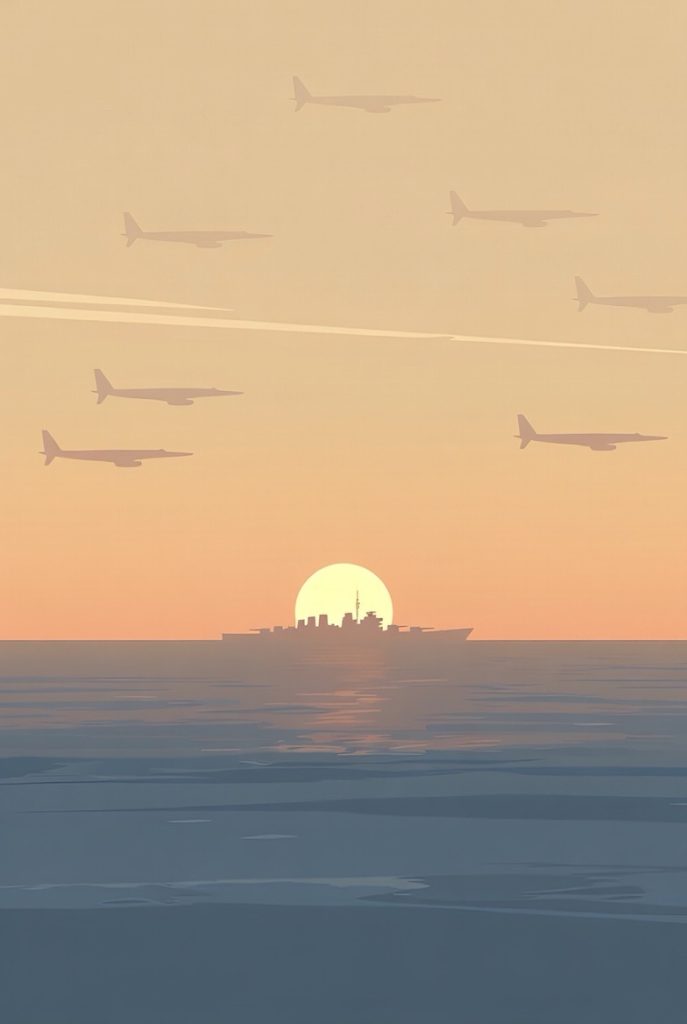
The attack on Pearl Harbor on December 7, 1941, marked the U.S.’s entry into World War II. Japan’s surprise strike on the U.S. naval base in Hawaii aimed to cripple the Pacific Fleet and secure resources in Southeast Asia. Despite early warnings, the attack devastated Battleship Row, sinking multiple ships and destroying aircraft. Over 2,400 Americans were killed, but the U.S. aircraft carriers, which were not in port, remained intact. The attack led to the U.S. declaring war on Japan and soon thereafter on Germany and Italy. The event reshaped global politics, catalyzed U.S. mobilization, and remains a symbol of resilience and sacrifice, with the USS Arizona Memorial serving as a tribute to the fallen.
Long Version
The Attack on Pearl Harbor: A Defining Moment in World War II
The attack on Pearl Harbor stands as one of the most pivotal events in modern history, marking the United States’ entry into World War II. On December 7, 1941, the Imperial Japanese Navy launched a devastating surprise attack on the U.S. naval base at Pearl Harbor, located on the island of Oahu in Hawaii. This air raid, executed as a pre-emptive strike, crippled much of the Pacific Fleet and resulted in significant casualties, ultimately drawing the nation into a global conflict that had already engulfed much of the world.
Historical Background and Rising Tensions
The roots of the Pearl Harbor attack trace back to escalating tensions between Japan and the United States, fueled by Japan’s aggressive expansionism in Asia. The Second Sino-Japanese War, which began in 1937 following the Marco Polo Bridge Incident, saw Japan invade China in pursuit of resources and territorial control. The United States, sympathetic to China, responded with economic measures, including loans to the Chinese government and the termination of the 1911 Treaty of Commerce and Navigation with Japan in 1939. As Japan aligned with the Axis powers—Germany and Italy—in 1940 and occupied French Indochina, the U.S. intensified its sanctions, freezing Japanese assets and imposing an embargo on petroleum and other vital materials in July 1941.
Diplomatic negotiations faltered in the fall of 1941, culminating in the Hull note, delivered by U.S. Secretary of State Cordell Hull on November 26. This document demanded Japan’s withdrawal from China and Indochina, which Japanese leaders viewed as an ultimatum. With resources dwindling and ambitions for dominance in Southeast Asia—including the Dutch East Indies, rich in oil—Japan’s militarists opted for war. Prime Minister Tōjō Hideki authorized the operation, seeing it as essential to secure Japan’s imperial goals. These pressures were compounded by Japan’s need to sustain its military campaigns, as the embargoes threatened to halt its war machine within months without new resource acquisitions.
Planning the Operation
The architect of the assault was Admiral Isoroku Yamamoto, commander-in-chief of Japan’s Combined Fleet. Yamamoto, who had studied in the U.S. and understood its industrial might, advocated for a bold pre-emptive strike to neutralize the Pacific Fleet, allowing Japan to conquer Southeast Asia without immediate interference. The plan involved a carrier task force under Vice Admiral Nagumo Chuichi, comprising six aircraft carriers, two battleships, three cruisers, and eleven destroyers, sailing stealthily from the Kuril Islands to a launch point 275 miles north of Oahu. This secretive voyage, spanning over 3,000 miles, relied on radio silence and refueling at sea to evade detection.
The operation incorporated innovative elements, such as midget submarines of the Ko-hyoteki-class, designed to infiltrate the harbor and torpedo ships at close range. These two-man vessels were deployed from larger submarines, though most failed to achieve significant impact—one was even depth-charged and another captured intact. The air component featured over 350 aircraft, including dive-bombers, torpedo bombers, and high-level bombers, trained for precision strikes on key targets. Pilots underwent rigorous simulations, focusing on low-level torpedo drops adapted for Pearl Harbor’s shallow waters, using wooden fins to prevent torpedoes from burying in the mud.
The Attack Unfolds
Early warnings went unheeded. At the Opana Radar Station on Oahu’s north shore, operators detected incoming aircraft around 7:02 a.m., but the signals were dismissed as an expected flight of B-17 Flying Fortress bombers arriving from California. In reality, these unarmed B-17s did arrive amid the chaos, with some coming under fire from Japanese fighters; one was damaged on landing, highlighting the vulnerability of U.S. forces that morning. The radar technology, still new and underutilized, represented a missed opportunity for early alert, as communication protocols failed to escalate the sighting promptly.
The assault began at 7:55 a.m., with the first wave of 183 planes targeting airfields and Battleship Row, where the Pacific Fleet’s battleships were moored. Dive-bombers and torpedo bombers struck simultaneously, while high-level bombers delivered ordnance from above. The naval base, submarine base, fuel tank farms, and naval repair facilities were primary objectives, though the fuel tanks—critical for long-term operations—were fortunately spared major damage. This oversight by Japanese planners proved costly, as the intact fuel reserves enabled quicker U.S. recovery.
Battleship Row bore the brunt of the attack. The USS Arizona was hit by multiple bombs, one penetrating near Turret II and detonating in the forward powder magazine, causing a catastrophic explosion that lifted the ship out of the water and sank it within minutes. Over 1,100 crew members perished, many trapped below decks. Nearby, the USS Oklahoma capsized after multiple torpedo hits, trapping hundreds inside, while the USS West Virginia settled to the harbor bottom with severe flooding but was later salvaged. Other vessels, like the USS Nevada, attempted to sortie but were beached to avoid blocking the channel.
Adjacent airfields suffered heavily. At Hickam Field, hangars and aircraft were strafed and bombed, destroying dozens of planes on the ground. Kaneohe Naval Air Station faced similar devastation, with seaplanes and facilities set ablaze. The second wave, arriving around 8:50 a.m., targeted remaining ships and infrastructure, prolonging the coordinated offensive for nearly two hours. Anti-aircraft fire intensified, downing several planes, but the initial surprise ensured overwhelming Japanese success.
Amid the horror, acts of heroism emerged. Doris “Dorie” Miller, a mess attendant aboard the USS West Virginia, assisted wounded sailors, including his mortally injured captain, before manning a .50-caliber machine gun—despite no formal training—and firing at incoming Japanese planes, downing at least one. His bravery earned him the Navy Cross, making him the first African American to receive the honor and symbolizing the contributions of underrepresented service members. Other stories include pilots like Kenneth Taylor and George Welch, who managed to get airborne and shoot down several attackers despite the odds.
Casualties and Damage Assessment
The toll was staggering: 2,403 Americans killed, including 2,335 military personnel and 68 civilians, with 1,178 wounded. The Pacific Fleet lost 18 ships damaged or sunk, including eight battleships, and over 300 aircraft destroyed or impaired. Japanese losses were minimal: 29 aircraft, five midget submarines, and 64 personnel. Critically, U.S. aircraft carriers were absent, at sea on maneuvers, preserving a vital asset for future campaigns. This absence shifted the war’s trajectory, as carriers became central to Pacific naval strategy in battles like Midway.
Broader Coordinated Offensive
The Pearl Harbor strike was part of a larger coordinated offensive across the Pacific. Within hours, Japan invaded Malaya, attacked Hong Kong, and struck U.S. possessions in the Philippines, Guam, and Wake Island. Singapore fell soon after, and advances into the Dutch East Indies secured oil supplies essential for Japan’s war machine. These moves aimed to establish a defensive perimeter in Southeast Asia, but they overextended Japanese forces and invited a prolonged Allied response. The simultaneous assaults demonstrated Japan’s strategic ambition but also sowed the seeds of overcommitment.
U.S. Response and Entry into War
The attack unified a divided America. On December 8, President Franklin D. Roosevelt addressed Congress, declaring December 7 “a date which will live in infamy” and requesting a declaration of war against Japan, which passed overwhelmingly. Germany and Italy declared war on the U.S. days later, formalizing America’s entry into World War II on both fronts. Commanders Admiral Husband E. Kimmel and Lieutenant General Walter C. Short were relieved amid investigations into preparedness failures, which revealed intelligence lapses and underestimation of Japanese capabilities.
Salvage efforts began immediately. Ships like the USS Oklahoma and USS West Virginia were righted and repaired, while the USS Arizona’s aft turrets were repurposed for coastal defenses on Oahu. Guns from Turret II were later installed on the USS Nevada, firing on Japanese positions at Iwo Jima and Okinawa. The industrial mobilization that followed transformed the U.S. economy, with shipyards producing vessels at unprecedented rates to rebuild the fleet.
Legacy and Remembrance
The attack transformed global warfare, accelerating U.S. mobilization and leading to victories in the Pacific. It exposed vulnerabilities in pre-war defenses but also demonstrated American resilience. Survivors like Ray Emory, who escaped the USS Honolulu and later dedicated his life to identifying unknown remains from the USS Oklahoma and other vessels, embodied the enduring commitment to honor the fallen. Emory’s efforts, spanning decades until his death in 2018, helped identify hundreds of service members, providing closure to families through DNA analysis and archival research.
Today, the USS Arizona Memorial, straddling the sunken hull, serves as a solemn tribute, with oil still seeping from the wreck as a reminder of the tragedy. The event reshaped international relations, underscoring the perils of isolationism and the importance of vigilance in an interconnected world. It also influenced post-war alliances, contributing to the formation of the United Nations and the U.S.-Japan security treaty, turning former enemies into allies. Annual commemorations on December 7 honor the sacrifices, fostering education about the costs of war and the value of peace.